Compounded semaglutide and tirzepatide, examined
For two years the shortage list let pharmacies make their own versions of the most wanted drugs in America. Then the shortages ended and the rules changed back. We explain what a compounder may still make, what the testing has found, and how to tell a careful pharmacy from a risky one.
C187H291N45O59
Compounded Weight Loss Drugs Under the Microscope
32 minutes. A narrated research briefing from the Compound GLP editors, with every source checked.
Read what the episode covers
Legal Gray Market for Unverified Compounded Injectables
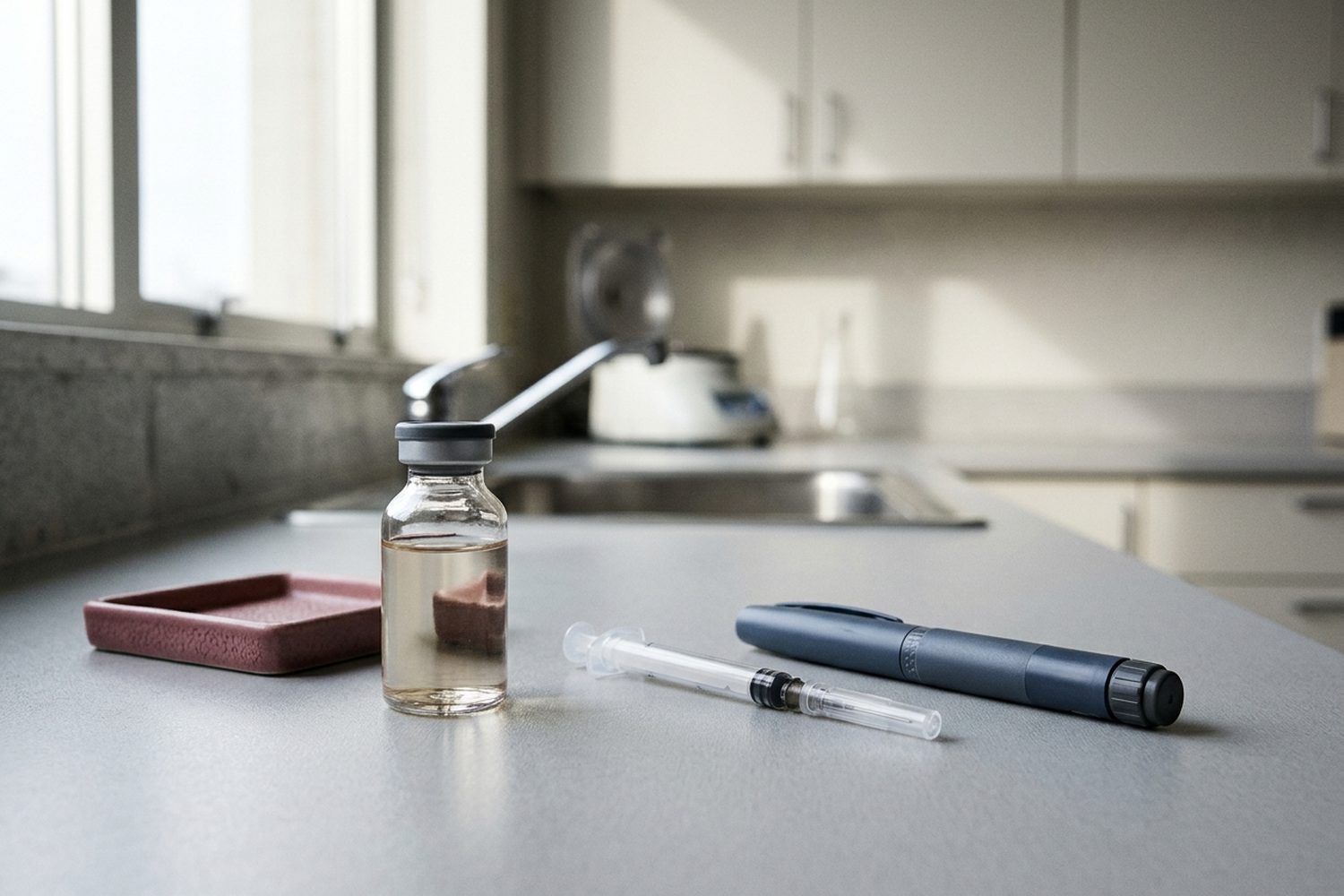
Someone in America in 2023 pulled a small vial out of a refrigerator, loaded a syringe, and injected themselves with a liquid whose potency they could not verify, whose salt form they had never heard of, and whose manufacturer they could not name. That person was not doing anything illegal. The pharmacy that sold it was not operating in a back alley. The whole transaction happened in broad daylight, under a legal framework Congress wrote in 2013 that nobody outside pharmaceutical law had thought much about.
That framework exists because of a disaster. In 2012, a pharmacy in Massachusetts called the New England Compounding Center shipped contaminated steroid injections to hospitals around the country. The product was tainted with fungal meningitis. By the time anyone understood what was happening, 64 people were dead and 753 were infected across 20 states. The compounding center had been operating largely outside FDA oversight because compounding pharmacies had always occupied a gray zone in federal drug law — close enough to manufacturing to be dangerous, just different enough to sidestep the rules.
President Obama signed the Drug Quality and Security Act on November 27, 2013. Public Law 113-54 had two titles: Title I was the Compounding Quality Act, which covered pharmacies, and Title II was the Drug Supply Chain Security Act, which tracked prescription drugs through the supply chain. Congress packaged them together, because nothing signals urgency like bundling your public health crisis response with supply chain paperwork.
The Compounding Quality Act created two categories of compounding pharmacy. A 503A pharmacy is a state-licensed pharmacy that compounds drugs for individual patients on valid prescriptions. Need a liquid version of a drug that only comes in pills? Allergic to a dye in the commercial product? A 503A pharmacist can handle that. Under 21 U.S.C. section 353a, a qualifying 503A compound is exempt from CGMP requirements, labeling requirements, and new drug approval — the FDA does not review it for safety, effectiveness, or quality before it reaches you. In exchange, 503A pharmacies are regulated primarily by state boards of pharmacy, must comply with USP chapters 795 and 797, and can only compound for identified individual patients on legitimate prescriptions. They can stockpile limited quantities in advance, but only based on a documented history of prescriptions from established patient relationships.
A 503B outsourcing facility operates differently. Congress created this tier for operations producing large batches without patient-specific prescriptions — facilities supplying hospitals and clinics with ready-to-use drug products. A 503B facility must register with the FDA, submit to inspections, and comply with current good manufacturing practice regulations under 21 CFR Parts 210 and 211. Those regulations were written for large pharmaceutical manufacturers. FDA-specific CGMP regulations written for outsourcing facilities remain in draft as of 2026, so 503B facilities operate under standards designed for companies like Pfizer while not being Pfizer. They still do not produce FDA-approved drugs. A compounded drug does not become FDA-approved because its active ingredient matches an approved one. The FDA's position on this has never wavered.
503A Copy Prohibition and the Shortage Carve-Out
Both categories operate under a baseline prohibition that would later become the central legal battleground for GLP-1 compounding. Under 21 U.S.C. section 353a, a 503A compounder cannot regularly or in inordinate amounts produce drugs that are essentially copies of commercially available products. There is a carve-out: if a prescriber determines a formulation change produces a significant clinical difference for a specific patient, that product is not considered a copy. But the baseline rule exists to stop pharmacies from manufacturing unapproved drugs at scale by calling themselves compounders.
For a 503A pharmacy to lawfully use a bulk drug substance — the raw active ingredient — one of three conditions must apply. The substance must comply with a USP or National Formulary monograph, be a component of an FDA-approved drug, or appear on an FDA-developed list of approved bulk substances. The bulk ingredient must also come from a registered manufacturer and be accompanied by a valid certificate of analysis. Three neat pathways. They would not stay neat once semaglutide became the most wanted drug in America.
The law the DQSA built had one significant trapdoor. Congress understood that sometimes a drug simply runs out. When that happens, patients who need it cannot get it, and the normal rules about copying FDA-approved products need some flexibility. So both Section 503A and Section 503B contain an exception: if a drug is on the FDA's official shortage list at the time a compounder makes it, distributes it, and dispenses it, compounding a copy of that drug is lawful. The statutory definition of a drug shortage is a period of time when the demand or projected demand for the drug within the United States exceeds the supply of the drug. Clean. Simple. The FDA is required by statute to maintain an up-to-date list of drugs meeting that definition.
In March 2022, Wegovy, Novo Nordisk's semaglutide injection approved for weight loss the previous June, appeared on that list. In August 2022, Ozempic joined it. Ozempic is the same active ingredient, marketed for type 2 diabetes, but by 2022 it had become famous for doing something diabetes drugs are not supposed to become famous for. Non-diabetic patients using GLP-1 drugs for weight loss grew from 21,000 in 2019 to 174,000 by 2023, a rise of more than 700 percent. Novo Nordisk could not make the drug fast enough. This is the rare corporate problem where the solution is also the problem, and the solution to that problem would also become the problem, which we will get to.
The shortage listings did not open a gray area. They opened a specific, defined exception that compounders had always known was there and had never had much occasion to use. Compounding a copy of an FDA-approved drug is ordinarily prohibited under federal law. The shortage exception made it legal, but only while the drug remained on the shortage list. The moment the FDA removed a drug from that list, the legal basis for copying it evaporated. Compounders knew this going in, which makes what happened next a matter of calculation rather than confusion.
What followed was a market that would have made anyone in pharmaceutical law reach for their blood pressure medication, which, in a nice bit of irony, they could probably have compounded. By October 2024, millions of patients were taking compounded GLP-1 medications. At peak, compounded versions accounted for up to 30 percent of total U.S. GLP-1 supply. The GLP-1 compounding market grew into a multibillion-dollar sub-industry. This was not some underground operation. It was specifically authorized by statute, operated in full daylight, and was reviewed by precisely nobody for safety or efficacy before the product reached patients. The FDA approved the branded versions. It approved nothing about the copies. That distinction matters more than it sounds.
503B Bulk Substance Rules Beyond the Shortage List
The 503B outsourcing facilities that wanted to compound at scale faced a separate requirement that the shortage exception alone did not satisfy. A 503B facility compounding from bulk drug substances needs the substance to appear either on the FDA's shortage list or on a separate document called the 503B Bulks List, which is a list of substances for which the FDA has determined there is a legitimate clinical need. These are distinct pathways that media coverage routinely collapses into one. A drug on the shortage list satisfies the 503B bulk substance requirement during the shortage. A drug on the Bulks List satisfies it permanently, shortage or not. For GLP-1 compounders, getting semaglutide onto the Bulks List would mean the shortage ending would not end the business. So in 2024, the Outsourcing Facilities Association nominated semaglutide, tirzepatide, and liraglutide for inclusion on that list.
The FDA reviewed the nominations and did not identify sufficient evidence of clinical need to place any of the three on the Bulks List. This was not a bureaucratic accident. When the FDA assesses clinical need for inclusion, the cost of the compounded product does not count, supply convenience does not count, and general backorder situations do not count. Clinical need means something specific: a formulation that the approved product cannot provide and that patients demonstrably require. Three drugs that ran short because demand exploded do not meet that bar on their own. The industry nominated them anyway, which suggests either genuine optimism about the FDA's definition of clinical need or a familiarity with regulatory timelines that made the nomination itself worth filing regardless of outcome.
On May 1, 2026, the FDA published a proposal to formally exclude semaglutide, tirzepatide, and liraglutide from the 503B Bulks List. The notice ran in the Federal Register as 91 FR 23431, filed under Docket No. FDA-2018-N-3240. The comment period originally closed June 30, 2026. The FDA then extended it to July 30, 2026 via a separate notice published on June 26. If the proposal is finalized, the last remaining regulatory pathway for large-scale 503B compounding of all three drugs closes. The shortage exception is already gone. The Bulks List was the fallback. The fallback is now proposed for elimination, which is a pretty tidy way to end a multibillion-dollar industry that never asked anyone's permission in the first place.
There was, however, a complication hiding underneath the shortage story that made the legal picture significantly worse for compounders, and it was chemical in nature. When pharmacies rushed to fill the semaglutide gap in 2022, many of them did not use semaglutide base — the specific molecular form inside every vial of Ozempic and Wegovy that Novo Nordisk ever made. They used semaglutide sodium or semaglutide acetate, which are salt derivatives of the same peptide. This distinction sounds like the kind of thing only a chemist would care about. It turned out to be the difference between a product that might be legal and a product that was not.
Novo Nordisk manufactures FDA-approved semaglutide through a proprietary semi-recombinant production process and does not sell the active ingredient to compounding pharmacies in any form. This created an immediate sourcing problem. Compounders who wanted bulk semaglutide API had to get it from somewhere else, and somewhere else turned out to be primarily Chinese chemical suppliers. A significant portion of those suppliers lacked FDA oversight or quality controls. The active ingredient traveling from an unregistered Chinese facility to an American pharmacy and then into a patient's arm is, depending entirely on your threshold for concern, either a minor supply chain detail or a description of an uncontrolled human experiment.
Salt Forms of Semaglutide Are Not Semaglutide
The salt forms those suppliers were selling — sodium and acetate variants — are chemically distinct from semaglutide base. Adding a sodium or acetate group changes the molecule's molecular weight and solubility characteristics and potentially alters its pharmacokinetics. These are not trivial modifications. The FDA's position, stated publicly and unambiguously, is that semaglutide sodium and semaglutide acetate are different active ingredients from the semaglutide base used in approved products. The agency further stated that using salt forms instead of the base creates greater potential for drug instability and variability, which increases the risk of adverse effects or therapeutic failure. The FDA also published materials containing a section specifically titled "Salt forms should not be used to compound semaglutide," which is about as direct as regulatory language ever gets.
The legal problem with the salt forms flows directly from the three-pathway structure covered earlier. Semaglutide lacks a USP or National Formulary monograph in any form, so pathway one is closed for the base and both salt forms alike. Semaglutide base clears pathway two because it is a component of an FDA-approved drug. Semaglutide sodium and semaglutide acetate do not — they are not components of any FDA-approved product, because no FDA-approved product contains them. Neither appears on the 503A bulks list either. Three pathways, zero hits. The salt forms satisfy none of the three conditions required for lawful bulk drug substance compounding under 503A or 503B.
On April 27, 2023, the FDA notified the National Association of Boards of Pharmacy that it was not aware of any basis for compounding a drug using semaglutide sodium or semaglutide acetate that would meet federal law requirements limiting the types of active ingredients that can be used in compounding. The FDA also clarified that the listing of Wegovy and Ozempic on the shortage website did not authorize the compounding of any salt form of semaglutide. The shortage exception opened the door for copying the approved product, not for substituting a chemically different analog and hoping nobody noticed.
The FDA further stated that it lacked information showing the salt forms share the chemical and pharmacologic properties of semaglutide base. No clinical studies exist confirming that semaglutide sodium or semaglutide acetate produces the same therapeutic effects, absorption rate, or safety profile as the base form used in every clinical trial that led to FDA approval. The approved drugs were tested as base. The pharmacology was established for base. The dosing guidance was developed for base. Patients injecting a salt form were receiving a molecule that had never been through that process, in a dose calibrated for a different molecule, with no data on whether any of it translated.
The Mississippi Board of Pharmacy formally notified licensees in writing that semaglutide salt compounding does not meet FDA bulk substance requirements and may draw action from FDA or the board itself. This was not the only state to weigh in, but Mississippi's written notification became one of the cleaner documented examples of a state regulator transmitting the federal position directly to pharmacists. Some compounders switched to semaglutide base after the shortage ended and after the FDA's position became unmistakable. Others continued using salt forms. The NABP notification came in April 2023. The shortage continued into 2025. That is a long window in which pharmacies were on written notice and kept filling prescriptions anyway.
Misbranding Exposure and Uninformed Patients
A pharmacy dispensing a salt-form semaglutide product labeled simply as semaglutide faced exposure to misbranding findings, state board complaints, and civil liability from patients never informed they received a substitute for the approved active ingredient. Whether those patients were informed is a separate question, and the answer is generally no, because the products were typically labeled as semaglutide without specifying salt form. The person with the syringe at the start of this story had no way to know which version they held, and the pharmacy that sold it may not have been forthcoming about the distinction, possibly because explaining it would require admitting the product was not what the label said it was.
So the regulatory scaffolding allowed millions of people to inject an unreviewed drug. The question of whether that turned out badly is answered, in part, by the FDA Adverse Event Reporting System — FAERS — which is the federal database where healthcare providers and patients report suspected drug problems. It is not a surveillance system in any precise epidemiological sense. It is closer to a suggestion box that you are legally allowed to fill out, which means the numbers reflect reporting behavior as much as actual harm rates. That caveat matters, and we will come back to it.
A 2026 pharmacovigilance study examined 81,078 GLP-1 receptor agonist adverse event reports in FAERS from 2018 through 2024. Of those, 707 involved compounded products. That is less than one percent of the total, which sounds reassuring until you remember that compounded GLP-1s represented up to 30 percent of supply at peak. Either compounded product users had dramatically better luck, or they were dramatically less likely to report problems, or there is some other explanation involving the words "significant underreporting." The study authors went with the third option.
What the numbers showed when researchers compared the 707 compounded reports against the rest was not reassuring. Compounded GLP-1 formulations had a reporting odds ratio of 48.92 for preparation errors — meaning the signal for preparation errors was nearly fifty times higher than in non-compounded reports. The 95% confidence interval runs from 12.63 to 189.6, which is the statistical equivalent of the error bars being wider than the chart. The signal is real. The exact magnitude is uncertain. What it is not is zero.
Contamination showed a reporting odds ratio of 19.00. Compounding and manufacturing issues came in at 8.51. Prescribing errors were 4.46. These are process failures — problems with how the drug was made or ordered, not side effects inherent to the molecule. That distinction matters because it means the elevated signals map directly onto the parts of the supply chain that no one was formally checking.
The clinical signals were also elevated. Cholecystitis — gallbladder inflammation — showed an odds ratio of 3.39. Abdominal pain was 2.84. Hospitalization was 2.35, with a confidence interval running from 1.94 to 2.83. Patients taking compounded GLP-1 products were hospitalized at more than twice the rate reflected in reports involving branded products.
The suicidality signal deserves its own sentence. Compounded GLP-1 formulations showed a reporting odds ratio of 6.34 for suicidality compared to non-compounded formulations. GLP-1 drugs have been entangled in a neuropsychiatric debate for years — the FDA has reviewed signals for depression and suicidal ideation across the entire class, with no definitive causal link established for the approved drugs. The elevated signal in compounded products is harder to interpret because patients using compounded versions may differ from patients using branded versions in ways the database cannot capture. A six-fold signal is not background noise, and anyone insisting it is has a financial interest in that conclusion.
Adverse Events, Overdose Reports, and Dosing Hazards
By April 30, 2025, the FDA had received 520 adverse event reports specifically related to compounded semaglutide. The agency issued alerts to healthcare providers about adverse events including hospitalizations possibly related to overdoses. Dosing is its own structural problem with compounded injectables — the standardized pen delivery systems in Ozempic and Wegovy have built-in dose controls. A vial with a syringe does not. Interestingly, the FAERS data showed compounded formulations had lower reporting odds for dosing errors and administration errors compared to non-compounded products, with odds ratios of 0.24 and 0.29 respectively. The study authors attributed this to underreporting rather than superior accuracy. Given everything else in the data, that attribution is correct.
Then there is the counterfeit dimension, which is separate from compounding but illustrates what happens when a drug supply chain expands faster than anyone can inspect it. In June 2024, the World Health Organization issued a global medical product alert after falsified semaglutide pens were identified in Brazil, the United Kingdom, and the United States. Some of those pens contained insulin. Insulin given to a person without diabetes can cause severe hypoglycemia — dangerously low blood sugar in someone who has no reason to expect it, no symptoms they would recognize, and no glucagon on hand. A patient who thought they were injecting a weight-loss drug and instead injected insulin is not a compounding problem. It is a supply chain integrity problem, and the two are not unrelated.
U.S. Poison Centers saw a 1,500 percent increase in calls related to injectable weight-loss drugs since 2019. That figure comes from a low baseline, but the trajectory is not attributable to improved public awareness about calling Poison Control.
The FAERS data carries a consistent disclaimer the study authors stated directly: spontaneous adverse event reports reflect reporting patterns, not incidence rates, and cannot establish causation. They require confirmation in population-based studies. What they can do is flag patterns. Preparation errors at nearly fifty times the non-compounded rate is a pattern. Contamination at nineteen times the rate is a pattern. The appropriate response to a pattern is not to wait for the population-based study while the pattern continues.
The adverse event data from FAERS tells one version of the compounded GLP-1 story. A second version requires no statistical methods. It just requires knowing that Ozempic comes in a prefilled pen with a preset dose, and that a compounded vial does not.
The FDA issued a MedWatch alert on July 29, 2024, directed at patients, healthcare professionals, pharmacies, and endocrinology specialists. The alert described adverse events, including hospitalizations, possibly related to overdoses from compounded semaglutide injectable products. The core problem was not a contaminated batch or a bad salt form. The core problem was arithmetic.
Ozempic and Wegovy are delivered via prefilled pens that inject a precise preset dose. You dial a number and the pen measures and injects. You do not measure anything yourself. This matters because semaglutide has a titration schedule that starts at 0.25 milligrams and climbs to a maintenance dose of 2.4 milligrams over several months. The drug is potent enough that being off by a factor of ten is not a rounding error.
Patients Calculating Their Own Doses from Multi-Dose Vials
Compounded semaglutide comes in multi-dose vials. The patient draws their own dose with a syringe. This requires converting the prescribed milligram dose into milliliters based on the specific vial's concentration, then translating that volume into the unit markings on the syringe they have been given. Different compounders sell different concentrations. The same milligram dose requires a different volume from different vials. Patients using U-100 insulin syringes need an additional conversion step because those syringes are calibrated for insulin units rather than milliliters. The formula for that conversion exists. Patients are not always given it.
A 2023 case series documented three patients who experienced adverse events after incorrect administration of compounded semaglutide obtained from compounding pharmacies and an aesthetic spa. Two of the three self-administered ten-fold dosing errors. One patient reported dosing in milliliters and units rather than milligrams. One received a vial with syringes and no pharmacist counseling on proper administration. All three experienced nausea, vomiting, and abdominal pain lasting multiple days. One additionally reported headache, anorexia, weakness, and fatigue. One sought care at a healthcare facility and responded to an antiemetic and intravenous fluids.
One of those sources was an aesthetic spa, a venue more commonly associated with facials than pharmaceutical-grade injectables. That is not editorializing. It describes the actual distribution network that developed during the shortage years.
The FDA's alert noted that dosing errors came from both patients measuring incorrectly and from healthcare providers miscalculating doses. Confusion between milligrams, milliliters, and syringe units was identified as a contributing factor. The agency warned that multiple concentrations were available from different compounders, and recommended that prescribers provide appropriately sized syringes and counsel patients on how to measure their dose. That recommendation amounted to the FDA telling prescribers to do the job the dispensing compounder did not do. Many patients who received compounded vials had no prior injection experience.
Semaglutide's elimination half-life is seven days. For most drugs, a dosing error resolves over hours. For semaglutide, a ten-fold overdose means ten times the intended dose circulating for roughly a week. The adverse events that can follow include acute pancreatitis and gallstones, not just nausea and a bad afternoon. Clinical management of a semaglutide overdose requires a prolonged period of observation and active treatment. The emergency department visit is not brief.
The FAERS reporting odds ratio of 48.92 for preparation errors in compounded versus non-compounded GLP-1 products has a clear structural explanation. The pen format eliminates most preparation errors by design. The vial converts every dose into a manual calculation performed by whoever holds the syringe. Dosing errors with a drug this potent, with a half-life this long, are not self-correcting. Compounded tirzepatide presents the same problem, supplied in multi-dose vials requiring patient-measured volumes and unit conversions. Poison control centers saw a more than fifteen-fold increase in calls related to injectable weight-loss drugs since 2019, and many of those calls involved dosing errors that are structurally more likely with compounded vials than with prefilled pens.
Quality Failures Versus Delivery-Format Failures Compounding
The formulation failures described earlier and the dosing failures described here are distinct. A contaminated batch is a quality failure. A ten-fold overdose drawn from a correctly labeled vial by a patient who did not understand the unit conversion is a delivery-format failure. Both were happening, to the same population, through the same unreviewed supply chain.
None of that — not the shortage window, not the salt forms, not the syringe math — answers the most direct question a patient could ask: was the stuff in the vial actually what the label said it was? The answer, when independent laboratories started testing compounded GLP-1 products systematically, was somewhere between "sometimes" and "please sit down."
The United States Pharmacopeia sets a potency window for sterile injectables: 90 to 110 percent of the labeled strength. That is the standard. A vial labeled as containing five milligrams of tirzepatide should deliver between four-and-a-half and five-and-a-half milligrams of active peptide. Below 90 percent, you are not getting what you paid for, and in a drug with a titration schedule designed around specific doses at specific weeks, getting 80 percent of your dose is not a minor inconvenience. It is a different treatment. FDA warning letters cited compounded semaglutide testing at 79.9 percent of labeled potency — below the 90 percent floor, in a product shipped to real patients. The same letters also documented over-labeling, where measured quantities ran from 101 to 132 percent of stated amounts. The range matters because underdosing causes therapeutic failure and overdosing causes adverse events, and the evidence suggests both were happening in the same market at the same time.
For tirzepatide specifically, independent testing flagged that roughly one in six vials fell below the 90 percent potency threshold, with some lots measuring as low as 72 percent of stated dose. Those numbers come from disputed and varied testing programs rather than a single controlled surveillance study, so the exact figures should be held loosely. The direction of the finding should not. A drug you inject once a week, calibrated precisely because its dose-response curve is steep, delivering anywhere from 72 to 132 percent of what the label says, does not have a consistent pharmacological effect. It has a range of effects. That range was entirely invisible to the patient injecting it.
Peptigrity, a platform that aggregates voluntary third-party laboratory submissions for peptide products, published a database of 1,062 tirzepatide tests showing an average purity of 99.75 percent across labs including ILS Laboratories, Accumark Labs, Krause Analytical, Freedom Diagnostics, Janoshik Labs, and Kovera Labs. That number sounds reassuring, and it would be, except that voluntary submissions skew toward batches the submitter expected to pass. A compounder with a bad lot does not typically pay for testing and then post the results publicly. The Peptigrity database is the most systematic aggregation available. It is not a random sample of the market.
The chemistry of why compounded peptides fail potency tests is not mysterious. Tirzepatide is most stable at a pH between 6.5 and 7.0. Moving the solution's pH just 0.4 units above that optimal range accelerates hydrolysis by 8 percent. Temperature is equally unforgiving: heat above 104 degrees Fahrenheit reduces active tirzepatide peptide by roughly 3 percent per minute. A compounding pharmacy reconstituting bulk powder with bacteriostatic water in an unvalidated cleanroom, without temperature controls, is not just cutting corners. It is conducting an uncontrolled degradation experiment. A five milligram weighing error on a fifty milligram batch produces a ten percent potency swing on its own, before pH or heat enter the picture. These are not exotic failure modes. They are the predictable consequences of working with sensitive peptides outside the infrastructure designed to handle them.
HPLC Testing Standards and 21 CFR 211.84 Requirements
High-performance liquid chromatography — HPLC — is the gold standard method for verifying compounded peptide potency. Lot-specific certificates of analysis using HPLC allow a pharmacist or patient to know what a specific batch actually contains before it reaches an arm. Federal regulations under 21 CFR 211.84 require 503B outsourcing facilities to perform identity tests on each shipment of every component lot, rather than simply accepting the supplier's certificate of analysis. FDA Form 483 inspection data suggests this requirement is inconsistently observed, which is a bureaucratic way of saying some facilities were trusting paperwork from Chinese suppliers without running their own tests.
A 2025 survey of compounded GLP-1 products found 33 unique semaglutide and tirzepatide formulations on the market. Forty-eight percent of those products contained drug combinations — additions like cyanocobalamin, glycine, niacinamide, and ondansetron alongside the active GLP-1 ingredient. Only 18 percent of surveyed products included beyond-use-date information. Combination products introduce pharmacological unknowns that the GLP-1 clinical trial data cannot speak to, because every trial that established the safety and dosing profile of semaglutide and tirzepatide was conducted with the single active ingredient, not a cocktail. A patient injecting a compound that contains ondansetron alongside tirzepatide is not taking a studied regimen. They are taking a hypothesis.
The compounded GLP-1 market that emerged from the 2022 shortage window was not a black market. It operated under a specific federal exception, with real prescriptions, real pharmacies, and real patients who had real reasons to want these drugs. Some of them got exactly what they needed at a price they could afford. Some of them got 72 percent of the molecule their prescriber had in mind. Some got 132 percent. Some got a molecule that never cleared a single clinical pathway. None of them, at the moment of injection, had any way to tell the difference. The legal framework that enabled all of it was written after 64 people died from a contaminated steroid. The law was designed to fix that problem. It created, in the process, a different set of conditions where a different group of people could be harmed in different ways at vastly greater scale. That is not evidence the law failed. It is evidence that drug regulation is less a solved problem than an ongoing negotiation between what we know at the time of writing and what we discover afterward, usually from the people who got hurt.
Start here
-
Compounded Semaglutide: What You Are Actually Getting
Compounded semaglutide explained: where the ingredient comes from, what testing it gets, why the multiple-dose vial caused dosing errors, and what followed the shortage.
-

Compounded Tirzepatide and the Shortage That Ended
Compounded tirzepatide lost its legal footing when the FDA ended the shortage in 2024. Here is what the deadlines, the Fifth Circuit ruling, and the lawsuits mean.
-

What Is a Compounding Pharmacy, and Why Did It Become a Weight-Loss Business?
What is a compounding pharmacy? A plain look at how patient-specific mixing became a mass GLP-1 supply chain, and what the FDA is now doing about it.
Everything else we have written
- Compounded GLP-1s With Added B12 or Glycine: Medicine or Marketing?
Semaglutide with B12 is compounded semaglutide plus cyanocobalamin, not an FDA-approved product. See what a 2025 survey and the safety data do and do not show.
- How to Check a Compounding Pharmacy Near You Is Legitimate
Searching for a compounding pharmacy near me is the quick check. Here is what a state license, 503A or 503B status, and FDA warning letters each tell you.
- What FDA Inspectors Write Down at Compounding Pharmacies
FDA 483 compounding explained: the top observation categories at outsourcing facilities, what a Form 483 is, and why GLP-1 warning letters keep turning to advertising.
- USP 797: The Rulebook for Sterile Compounding
USP 797 sets sterile compounding rules, and its beyond-use date quietly shapes compounded GLP-1 supply, from one syringe to the end of a federal shortage.
- Compounded vs Brand Semaglutide: The Differences That Matter
Compounded ozempic is not Ozempic. A side-by-side of source, testing, vials and the 'essentially a copy' rule, plus where the law stands after the shortage.
- How Telehealth Weight-Loss Brands Built a Business on Compounders
A compounded GLP-1 sold online often carries the telehealth brand's name, not the pharmacy's. Here is how the shortage rules, ad law and FDA letters fit together.
- What Independent Labs Found When They Tested Compounded Semaglutide
Compounded semaglutide testing is mostly after-the-fact: FDA letters cite 79.9% potency, tirzepatide labs show wide spreads, and dosing errors loom larger.
- How to Judge a Compounding Pharmacy's Quality
No official list names the best compounding pharmacy. Learn the four checkable signals: PCAB accreditation, USP 797, testing and API sourcing, and how to read them.
- The Compounded GLP-1 Lawsuits: Novo, Lilly and the Outsourcing Facilities
Compounded semaglutide lawsuit explained: the OFA challenge to the FDA shortage ruling, Novo Nordisk's 132 complaints and 44 injunctions, and a patent suit.
- Why Compounded Tirzepatide Costs What It Costs
Compounded tirzepatide cost has no published figure. Here is what the sources show on pricing: semaglutide at $150 to $400, brand drugs falling, and a hidden markup.
- The Dosing Errors FDA Keeps Seeing With Compounded GLP-1s
Compounded semaglutide dosing errors, per the FDA's July 2024 alert: patients drew up 5 to 20 times the intended dose from multiple-dose vials, and why.
- Is Compounded Semaglutide Safe? What the Evidence Shows
Is compounded semaglutide safe? No trial has tested it. The safety record is mostly reports of vial dosing errors, plus thinner evidence on potency and ingredients.
- Semaglutide Sodium and Acetate: Why the Salt Form Matters
Semaglutide sodium is not the semaglutide in Ozempic or Wegovy. See why FDA says no lawful compounding route exists and what the missing data means.
- What Happened When the GLP-1 Shortages Ended
Is compounded semaglutide still legal? Only narrowly: 503A pharmacies can personalize for one patient, while mass copying ended with the shortage in February 2025.
- The Semaglutide Shortage: How a Drug Gets on the List and Off It
The semaglutide shortage ended legally on February 21, 2025, by FDA order. Learn why a list, not pharmacy shelves, decided who could compound, and what followed.
- Inside a 503B Outsourcing Facility
A 503B outsourcing facility trades the light pharmacy rulebook for factory rules and FDA inspections. Learn what it may make and why GLP-1 batches ended.
- 503A vs 503B: The Two Kinds of Compounder the Law Allows
A 503a pharmacy compounds only against a patient-specific prescription under state board oversight. See how that differs from a 503B outsourcing facility and why.
| Question to ask | What a good answer sounds like |
|---|---|
| Are you a 503A pharmacy or a 503B outsourcing facility? | A 503B facility is registered with the FDA and inspected against manufacturing rules. A 503A pharmacy answers mainly to its state board. |
| Which form of the molecule do you use? | The base peptide, not a sodium or acetate salt. |
| Does an outside lab test every batch? | Potency, sterility and endotoxin results, shown without being chased. |
The full scorecard has twenty questions drawn from FDA inspection findings, USP standards and independent potency testing, with what a good and a worrying answer sound like for each.
The Compounding Pharmacy Quality Scorecard
Twenty questions that separate a careful compounder from a risky one, drawn from FDA inspection findings, USP standards and independent potency testing, with what a good answer sounds like.