The Dosing Errors FDA Keeps Seeing With Compounded GLP-1s
The FDA found the drug in the vial was not the main problem; the problem was how much people pulled out of it.
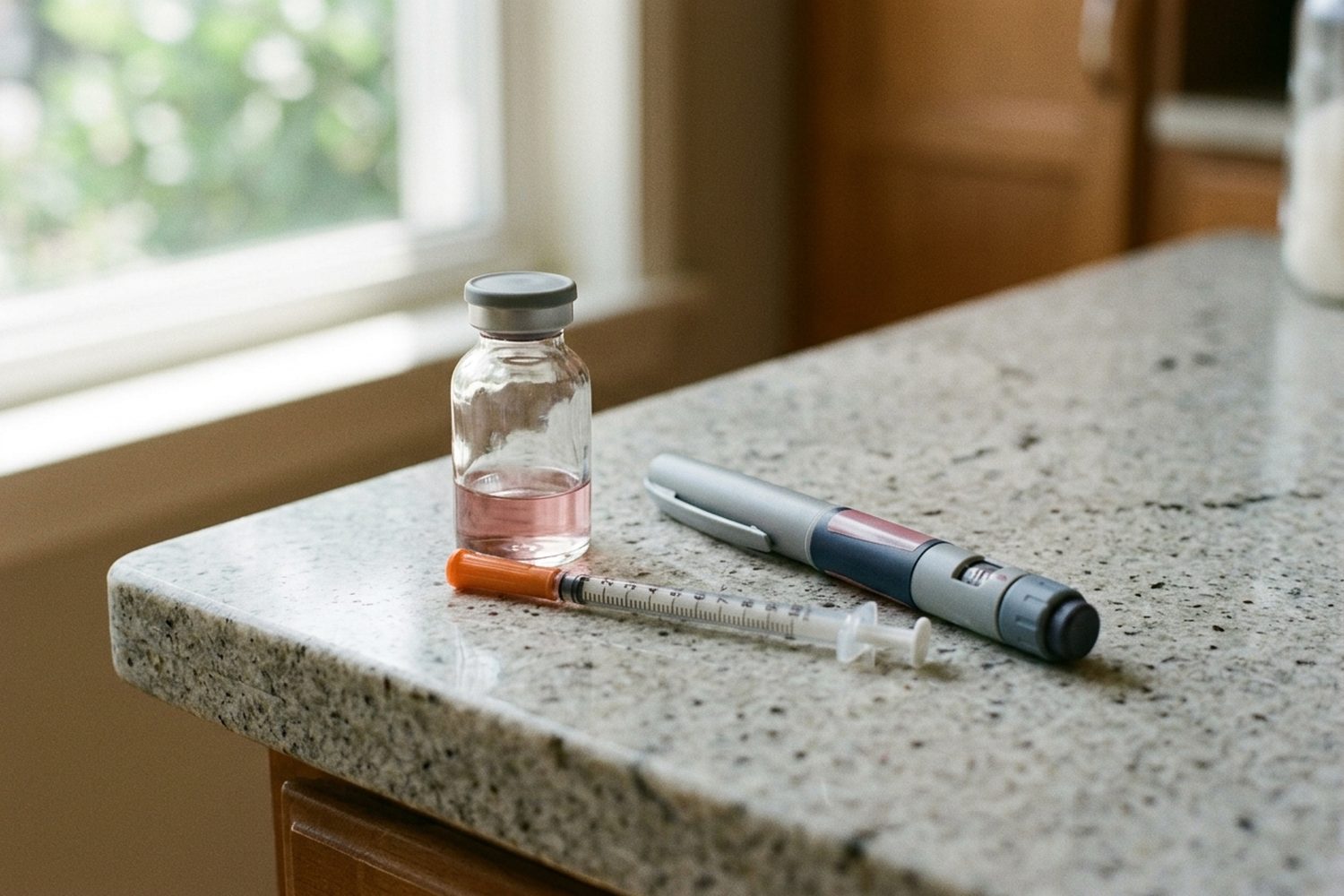
On July 29, 2024, the Food and Drug Administration put out a MedWatch alert about people injecting themselves with far too much compounded semaglutide. The alert went to patients, health professionals, pharmacies and endocrinology specialists, which is sort of everyone who touches the stuff. Its main finding was not that the drug in the vials was wrong. It was that people were drawing the wrong amount out of them.
So here is the plain answer on compounded semaglutide dosing errors. The FDA said most of the reports it received involved patients drawing more than the prescribed dose out of a multiple-dose vial, and that confusion between milligrams, milliliters and syringe “units” contributed. In the reported cases, patients took five to 20 times the intended dose, and some were hospitalized. Health care providers also miscalculated doses, so this was never only a patient problem.
The one FDA sentence that explains the dosing errors
The alert has one sentence that does most of the work, and it is worth reading the way a lawyer reads an indemnity clause. The FDA MedWatch alert says: “The majority of FDA-received dosing error reports described patients mistakenly drawing up more than the prescribed dose from a multiple-dose vial during self-administration of compounded semaglutide.”
Let’s take it clause by clause.
“The majority.” That means not all. Elsewhere the alert says errors came from patients measuring and injecting incorrect doses and also from health care providers miscalculating doses. So there is a minority of reports where the person holding the syringe did the math correctly and the math they were handed was wrong. That’s a weird category to have at all. (It is also the category that should worry the people writing the instructions.)
“Of FDA-received dosing error reports.” This is a statement about reports, not about patients. The FDA counts what people tell it. By April 30, 2025, it had received 520 adverse event reports related to compounded semaglutide. That is a count of forms. It is not a rate, because nobody in the facts here knows how many people were injecting the stuff.
What “the majority of reports” can and cannot tell you
The report problem gets stranger. A pharmacovigilance study using the FDA’s adverse event database from 2018 to 2024 found that compounded GLP-1 products had lower odds of dosing errors than non-compounded ones, with a reporting odds ratio of 0.24. A reporting odds ratio asks: among the reports filed about this product, how often is this problem mentioned, compared with reports about other products? So among reports about compounded GLP-1s, dosing errors showed up proportionally less often than among reports about the branded ones.
That sounds like the opposite of the FDA alert. It may not be. A pharmacist writing at PrecisionOptimize said most adverse events reported for compounded semaglutide appear to be dosing errors rather than formulation failures. Both claims can hold at once, because one is about the inside of a pile of reports and the other compares two piles. What the true error rate per patient is remains, on these facts, not settled.
Also, branded users make mistakes too. America’s Poison Centers says poison centers are most often contacted about accidental errors with the FDA-approved GLP-1 drugs, like doses taken too close together or higher than recommended. Poison centers reported a more than 15-fold rise in calls about injected weight-loss drugs since 2019, with many dosing errors more common with compounded multi-dose vials. The errors are ordinary. The size is not.
Why a multiple-dose vial turns a dose into a math problem
“Mistakenly drawing up more than the prescribed dose from a multiple-dose vial.” Here is the mechanism in plain words. You put a month or so of medicine in one little bottle, hand someone an empty syringe, and ask them to pull out the right sliver of it each week at the kitchen counter. The official name for this is a “multiple-dose vial” dispensed for “self-administration.”
The branded drug mostly comes in a prefilled pen, where you set a dose and the device does the measuring. A case series of calls to a poison control center put the difference flatly: “Vials of compounded semaglutide do not include the safety features provided by prefilled manufactured pens, making large overdoses (e.g., 10-fold dosing errors) possible.” A pen has a ceiling. A vial has a plunger and whatever is left in the bottle.
And the people holding the vials were often new to this. The FDA’s reports said many patients who got compounded vials lacked experience with self-injections. One account of the alert says some patients drew up several times the intended amount because the vial labeling differed from the pen format they had read about. They had studied for the wrong test. (This is the IKEA problem: the instructions show a different bookshelf than the one in the box, and you are holding a needle instead of an Allen key.)
“During self-administration.” At home. Alone.
Milligrams, milliliters and “units” on the same syringe
The FDA identified confusion between milliliters, milligrams and “units” as a contributing factor. Between us, “units” is the word doing the most damage in this story. A milligram is an amount of drug. A milliliter is an amount of liquid. A “unit” is a tick mark on a syringe. Turning a prescription in one into a pull on the plunger in another requires knowing the concentration and doing a conversion, and every step is a chance to be off by a factor of ten.
The 2023 poison center case series is small, three patients, but two of the three gave themselves 10-fold dosing errors. One patient reported dosing in milliliters and units rather than milligrams. Look, a decimal point is a very small object.
A purely invented illustration of how it goes. The vial label speaks milligrams per milliliter. The prescription speaks milligrams. The syringe speaks units. A helpful person at the clinic calls and says, “Hey, so it’s ten on the syringe, not ten milligrams, and definitely not ten milliliters, ha.” The patient writes down “ten.” Next month the vial is a different concentration (made up, again), the syringe is a different size, and the patient is now a currency trader running a three-way conversion across milligrams, milliliters and units, with no Bloomberg terminal and a sharp object. By month three they are hedging. None of that is a real case. It is just the shape of the arithmetic.
What happened to the people who got the math wrong
The FDA said it received reports of adverse events, “some requiring hospitalization, that may be related to overdoses due to dosing errors.” The listed effects were nausea, vomiting, abdominal pain, fainting, headache, migraine, dehydration, acute pancreatitis and gallstones. The doses in those reports ran five to 20 times what was intended.
The FDA’s fix, among its recommendations, was that health care providers and compounders give patients the appropriate syringe size for the intended dose. If the syringe can only hold a small amount, you can only draw a small amount (physics remains an underrated regulator). It’s fine.
It is also a revealing fix. When the answer to a drug safety problem is “use a smaller cup,” the problem was never the chemistry.
Why the system put vials in kitchens in the first place
Compounding a copy of an approved drug is ordinarily prohibited, but semaglutide and tirzepatide were on the FDA shortage list starting in 2022, and the shortage exception let compounders make them (other articles on this site cover how that list works). Compounders made what compounders make, which is vials. Telehealth brands sold subscriptions, and the line between a pharmacy, a prescriber and a marketing funnel got blurry: shared branding, shared customers, a shared checkout page, a shared interest in the refill.
Anyway, the shortage ended, and the FDA said compounded semaglutide and tirzepatide could not be distributed after May 22, 2025. On September 16, 2025, it sent more than 55 warning letters to online sellers. On February 6, 2026, it announced steps to restrict the active ingredients themselves. The 2024 alert about plungers and tick marks was, lol, one of the earlier and smaller items in a long file.
None of this required anything to be wrong with the molecule. The medicine came in a bottle, and the bottle came with homework.
Sources
- FDA MedWatch - FDA Alerts Health Care Providers, Compounders and Patients of Dosing Errors Associated with Compounded Injectable Semaglutide Products
- FDA alerts health care providers, compounders of dosing ...
- Administration errors of compounded semaglutide reported to a poison control center-Case series
- America's Poison Centers - GLP-1
- Compounded GLP-1s: Why doctors worry and the FDA is cracking down
- Semaglutide Compounding Pharmacy: What's Legal In 2026
- Safety analysis of compounded GLP-1 receptor agonists: a pharmacovigilance study using the FDA adverse event reporting system
- The Shot Heard ‘Round the Pharmacy’: FDA Takes Aim at GLP-1 Compounders | ArentFox Schiff
- Semaglutide Salt Forms: Why the Base Matters
- FDA and Novo Nordisk Warned of GLP-1 Telehealth Compounding Takedown. What’s Next? | Pharmacy Times
- Businesses continue to sell compounded semaglutide, tirzepatide
- Compounded Semaglutide Dosage Chart: Titration Guide
- Compounded Semaglutide vs. Ozempic: What's the Difference? | PrecisionOptimize
- Compounded Semaglutide: Meaning and Why Regulators Warn
Compound GLP explains the law and published research. It is not medical or legal advice, and it never recommends a dose, a pharmacy or a product. Talk to a clinician before you start, stop or change any medicine.