How to Check a Compounding Pharmacy Near You Is Legitimate
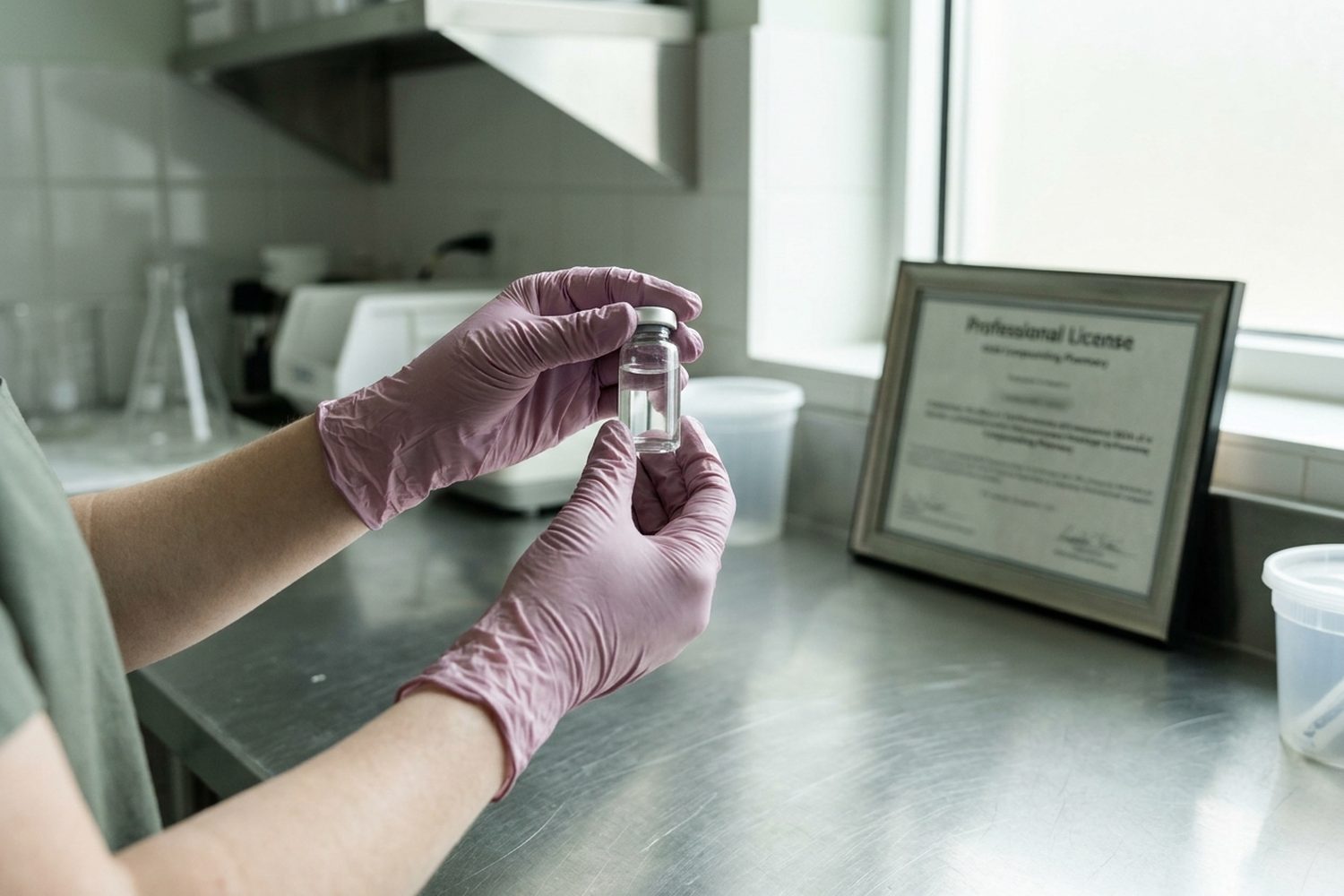
A license on the wall answers whether a pharmacy may compound, and says little about whether this particular vial is the kind the rules allow.
There are two ways to find out whether a compounding pharmacy is legitimate, and they end up in roughly the same place. The quick way is to type “compounding pharmacy near me” into a search engine, click a result, and notice that it has a storefront, a phone number and a pharmacist with a name tag. The slow way is to confirm the pharmacy’s license with the state board of pharmacy, work out whether it is a 503A pharmacy or a 503B outsourcing facility, check for optional accreditation, look for FDA warning letters, and ask what exactly is going into the vials.
The slow way produces a plain answer. For an ordinary neighborhood compounder, legitimacy mostly means a state license. Federal law lets a 503A pharmacy compound when the work is done by a licensed pharmacist in a state-licensed pharmacy (or a federal facility, or by a licensed physician). These pharmacies are regulated primarily by state boards rather than the FDA, and they are not required to register with the FDA at all. So the license is the thing, the state board is where it lives, and most of the rest of the checking is about what a licensed pharmacy is doing with that license.
What a search for a compounding pharmacy near you turns up
It turns up a lot, and the reason is GLP-1s. Compounders entered that market in 2022, when demand for semaglutide and tirzepatide outran supply and both drugs went onto the FDA Drug Shortage List. The law firm ArentFox Schiff describes what followed as a “multibillion-dollar sub-industry,” which is a nice way of saying that a corner of pharmacy built mostly for odd doses and allergy-free formulations suddenly found itself in the weight-loss business. At the 2024 peak, nearly 1 in 3 Americans taking a GLP-1 said they got it from a compounding pharmacy.
The legal basis for all that was narrow. Copying an FDA-approved drug is ordinarily prohibited. The exception in sections 503A and 503B allows a copy only while the approved product is on the shortage list “at the time of compounding, distribution, and dispensing” (all three, not just one of them). The shortage was the whole permission slip.
Then the slip expired. The FDA issued a declaratory order on February 21, 2025 resolving the semaglutide injectable shortage, and gave 503A pharmacies until April 22, 2025 and 503B outsourcing facilities until May 22, 2025 to stop compounding under the shortage exception. The search results did not all get the memo at the same speed. (Search results rarely do.)
The dumb version: the sign on the wall
The dumb version of checking legitimacy is to look at the pharmacy and conclude that it looks like a pharmacy. It has a counter. It has a pharmacist who says, “Hey, yes, we’re fully licensed, it’s on the wall right there.” It has a website with a photo of someone in gloves holding a vial up to the light, which is the universal sign for science.
I mean, this is roughly how everyone picks a restaurant. There is a health inspection grade taped in the window, and people mostly trust that it was earned and that it still applies. That trust is usually correct.
The point is that the dumb version is not crazy. A pharmacy with a real address and a pharmacist answering the phone is, most of the time, a pharmacy holding a real state license, because operating one without a license is the kind of thing that tends to come up (usually at an inconvenient moment for the operator).
The sophisticated version: the state board, then everything else
The sophisticated version starts at the same wall but takes the certificate down and checks it. The state board of pharmacy issued the license, so the board is the authority on whether the license exists and is in good standing. For a 503A pharmacy, that is close to the whole regulatory picture: such pharmacies must follow USP <795> and USP <797> (the sterile one) plus state rules, and a pharmacy compounding for a specific patient’s prescription is exempt from the federal CGMP framework in 21 CFR Parts 210 and 211.
Next comes the question of which kind of compounder this is, because the word “pharmacy” covers two very different animals. A 503B outsourcing facility can compound large volumes from bulk ingredients without individual prescriptions, and in exchange it must meet CGMP, the manufacturing rulebook, on top of state requirements. So the FDA is the more natural place to ask about a facility that claims 503B status, and the state is the place to ask about the neighborhood shop. A storefront that describes itself both ways is describing something.
Then there are the optional extras. The Pharmacy Compounding Accreditation Board offers third-party accreditation. Optional is doing real work in that sentence. Accreditation tells you the pharmacy volunteered to be looked at, which is information, though it is information about the pharmacy’s appetite for inspection rather than about any particular vial.
Then there are warning letters, which are where the FDA writes down, in public, what it found. And here the sophisticated version picks up some odd results, because the parties named are not always pharmacies. FDA warning letters to telehealth companies have named the platform itself, and not just the compounder behind it, as the party responsible for misbranding. So a patient might check the pharmacy carefully and the problem might be the website that sent the prescription there.
What the red flags in the paperwork look like
The most famous red flag is a chemistry question that turns out to be a legal one. Federal law gives a bulk ingredient in 503A compounding three ways to be lawful: it meets a USP or NF monograph, it is a component of an FDA-approved drug, or it appears on an FDA-developed list. Semaglutide sodium and semaglutide acetate fail all three. On April 27, 2023, the FDA told the National Association of Boards of Pharmacy that it was “not aware of any basis” for compounding with those salt forms that would satisfy federal requirements. The Mississippi Board of Pharmacy then told its licensees in writing that salt compounding may draw action “from FDA or the board itself.” (The other articles on this site go into why the salt matters; here it matters because it is written down.)
This is the place where the two versions diverge most sharply, at least on paper. A pharmacy can hold a spotless license and still be making the thing the licensing system has said it should not make. The license is about the pharmacy. The salt is about the product.
The second kind of red flag shows up in what inspectors write. On September 18, 2026, the FDA sent a warning letter to a Houston compounding pharmacy citing “pretextual significant-difference determinations.” Translated: the pharmacy said its version was different from the approved drug so it could keep making it, and the FDA did not believe the difference was real. The same letter cited “boilerplate prescribing records,” which is prescriptions that all look suspiciously alike, and “rewritten media fill records,” which is the sterile-compounding version of finding that someone has gone back and edited the diary. It also cited “inadequate smoke studies,” a phrase that makes the clean room sound like it has been having a more interesting weekend than the paperwork admits, and that refers, I assume, to something much duller involving air.
The third kind of red flag is the shortage calendar itself. If a drug is no longer on the list, the copying exception is gone, and a pharmacy still advertising a copy is relying on something else. Sometimes that something else is a claimed significant difference. See above.
Where both versions end up
Here is a scenario, entirely made up. A patient runs the full sophisticated version on a pharmacy. The state board confirms an active license. The pharmacy is plainly 503A and says so. It is accredited. No warning letters. She then calls and asks which salt form they use, and the pharmacist, to be fair, answers honestly. She asks to see the media fill records, and they show her. She asks about smoke studies, and they invite her in to watch. By week three she is spending more time in the clean room than the technicians, and the board offers her a job, and now she is the one doing the license checks.
And what did she learn? Mostly that the pharmacy was licensed by the state. Which is what the sign said.
On the other hand, the long road does buy something the short one cannot: the questions about the product. The license answers whether this business may compound. The salt letter, the shortage dates and the warning letters answer whether this particular compounding is the kind the rules allow. Those are different questions, and only one of them is printed on the wall. You and I both know which one gets searched for.
There is also a gap neither version closes. In a 2023 case series of compounded semaglutide errors reported to a poison control center, one patient got a vial and syringes for self-administration with no pharmacist counseling on how to use them. A license lookup does not tell you whether anyone will explain the syringe. It’s fine; that is not what a license lookup is for. Anyway, the most thorough possible check of a compounding pharmacy ends at a licensed professional who has to be trusted to do the job right, which is also where the quickest possible check ends, so the truly sophisticated move would be to check the pharmacist’s license, and then the license of whoever checked that.
Sources
- Compounded Semaglutide vs Brand Name Comparison: What's Actually in Your Injection?
- Semaglutide Salt Forms: Why the Base Matters
- FDA clarifies position on compounding semaglutide sodium
- 21 U.S. Code § 353a - Pharmacy compounding | U.S. Code | US Law | LII / Legal Information Institute
- FDA Warning Letters to Telehealth Companies Selling Compounded Drugs
- Compounded GLP-1 Marketing After the Shortage Ended
- Is your compounded semaglutide and tirzepatide safe?
- Compounding After a Drug Leaves the Shortage List
- The Shot Heard ‘Round the Pharmacy’: FDA Takes Aim at GLP-1 Compounders | ArentFox Schiff
- Compounded GLP-1s: Why doctors worry and the FDA is cracking down
- The FDA Removes Semaglutide from the Drug Shortage List
- 503A vs. 503B: A Quick-Guide to Compounding Pharmacy Designations & Regulations
- cGMP Expectations for Outsourcing Facilities
- Administration errors of compounded semaglutide reported to a poison control center-Case series
Compound GLP explains the law and published research. It is not medical or legal advice, and it never recommends a dose, a pharmacy or a product. Talk to a clinician before you start, stop or change any medicine.