Inside a 503B Outsourcing Facility
A pharmacy that agrees to be treated like a factory gets to make big batches, but not necessarily the batches everyone wanted.
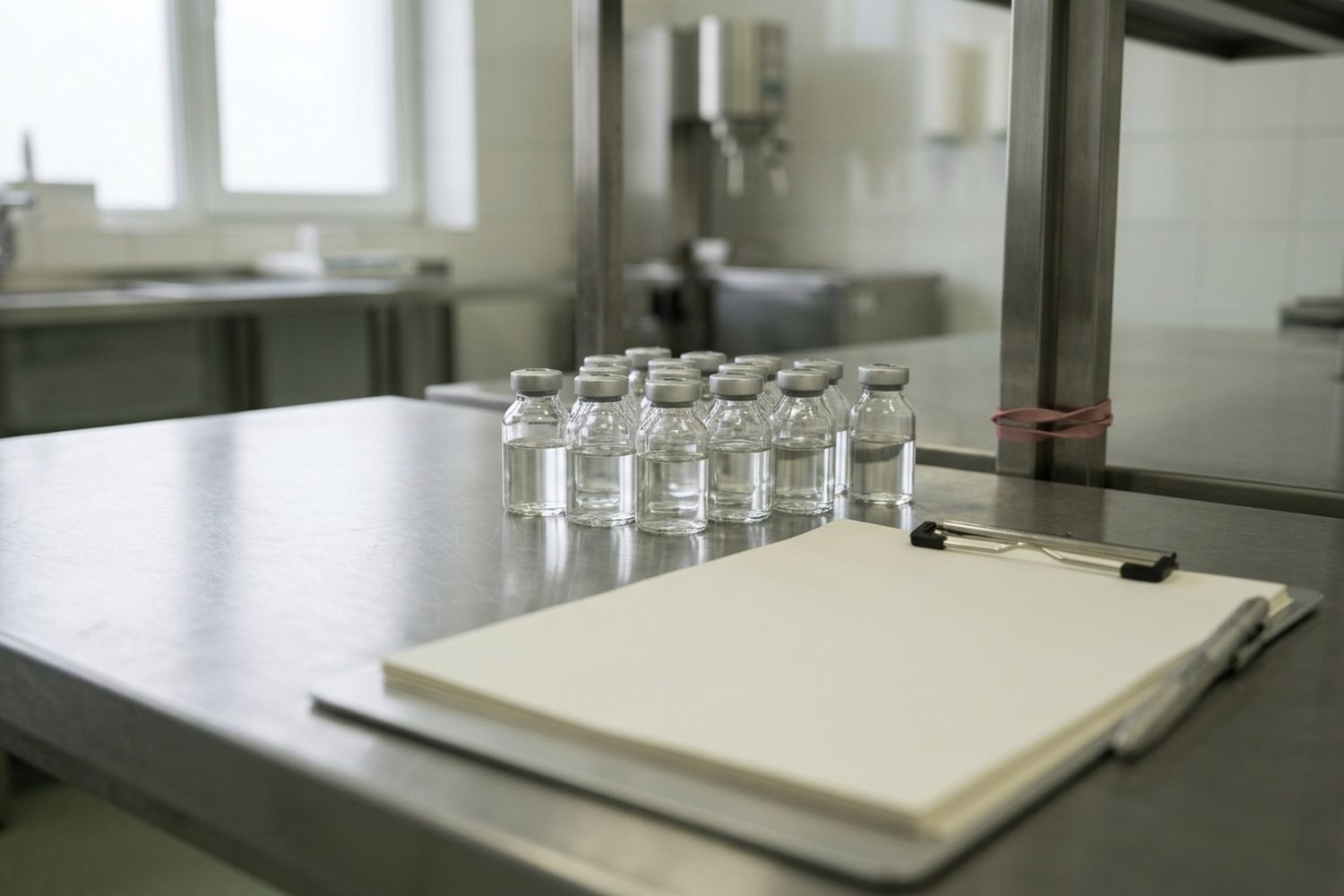
A 503B outsourcing facility is a pharmacy that has agreed to be inspected like a drug factory in exchange for being allowed to behave a bit like one. It registers with the FDA, follows the federal manufacturing rules called current good manufacturing practice (CGMP, under 21 CFR Parts 210 and 211), and submits to regular FDA inspections. In return it may produce large batches of drugs without a prescription for each individual patient. What it makes is still not an FDA-approved drug.
The catch is what it may make. When a 503B outsourcing facility compounds from bulk drug substances (the raw powder, basically), the drug generally has to appear on the FDA’s 503B bulks list or on the FDA drug shortage list. Separately, the law generally prohibits compounders from making a copy of a commercially available, approved product unless that product is on the shortage list. That is why compounded semaglutide and tirzepatide went from a large business to a wind-down. The shortages ended, and the GLP-1s were on neither list.
Start with one pharmacist and one prescription
Here is an invented pharmacist, Dana, who exists only for this paragraph and the next few. A doctor sends her a prescription for a patient who needs a drug in a form nobody sells (a different strength, no dye, that sort of thing). Dana mixes it. Under 503A, a qualifying compounded product like that is exempt from CGMP, from the federal labeling requirement and from new drug approval. That’s fine. One patient, one vial.
Then Dana notices the same prescription arrives every Tuesday, so she makes ten on Monday. In some sense she is now forecasting demand, which is what manufacturers do, but the names still show up eventually.
Then a hospital calls. “Hey, can you just send us 500 syringes? We’ll match them to patients as they come in.” Now there are no names. Dana is making a product and shipping it to a customer who will decide later who gets it.
Then it is 50,000 vials a month, made from bulk powder, shipped to clinics in a dozen states, none of it tied to any patient. This is If You Give a Mouse a Cookie, except the cookie is a sterile injectable and the mouse is a hospital purchasing department. At the end of the road Dana runs a pharmaceutical plant whose product never went through an approval, operating under rules written for someone mixing one cream at a counter.
You would think the law forbids that endpoint. It mostly said: fine, register.
What registering as a 503B outsourcing facility actually means
Put plainly, the arrangement is this: a pharmacy may stop asking for the prescription if it agrees to be treated like a factory. The official name for a pharmacy that takes that arrangement is an outsourcing facility, under Section 503B of the Food, Drug, and Cosmetic Act. A 503A pharmacy compounds only against patient-specific prescriptions and answers to USP <795> and <797> plus its state board. A 503B facility may make large batches with or without prescriptions, but must comply with full CGMP under Parts 210 and 211, on top of state board of pharmacy rules.
So registration is a trade. You give up the light rulebook and get the heavy one, plus inspectors. The product does not become approved along the way (the facility gets inspected, the drug in the vial does not get reviewed the way an approved drug does).
There is a second registration for facilities that handle controlled substances, and it rests on a point that deserves to be set out with proper formality. Let it be entered into the record, for the avoidance of doubt, that making a great many of something is a different activity from making one of it. The DEA concurs. A 503B facility handling controlled substances generally must register as a manufacturer rather than a dispenser, because batch production falls outside the practitioner exclusion in 21 U.S.C. 802(15). If you make it in batches, you are a manufacturer. Hard to argue.
On the reporting a facility sends to the FDA, the sources here say very little, so I won’t fill it in. What they do describe is the paperwork the FDA sends back, which comes up below.
The factory rules: CGMP, stability data and the clean room
Section 501(a)(2)(B) of the FD&C Act is what requires outsourcing facilities to follow CGMP. Which CGMP, though? A Health Law Alliance article by Diana Yastrovskaya, published August 7, 2026, says the FDA applies Parts 210 and 211 “until it finalizes CGMP regulations written specifically for outsourcing facilities,” and those were still in draft. The FDA has been releasing guidances on what it expects of 503B facility space since at least October 2017. The bespoke rulebook is still being written. In the meantime, the general manufacturing one applies.
What that means in practice: every process gets validated. Before a new product goes to market, the facility must produce multiple batches and submit them for testing and stability. Beyond-use dates (how long the vial is good for) are expected to rest on stability data for that specific formulation, rather than the default categories a 503A pharmacy may lean on under USP <797>. A 503A pharmacy can look up a shelf life. A 503B has to earn it.
Then the clean room. Under 21 CFR 211.42(c)(10)(iv), an outsourcing facility must keep “a system for monitoring environmental conditions in its aseptic processing area on an ongoing basis.” The federal government, in other words, would like to know what goes on in that room at all hours, and it would like it written down. (I have now read Part 211 for fun, which is the sort of thing I mention at parties right before people find someone else to talk to.)
Inspectors write down what they find on Form FDA 483. Facility control system failures ranked second among 483 observation categories for outsourcing facilities, at roughly 13 percent. Past the 483 there is the warning letter; the FDA issued one on March 20, 2026, to RC Outsourcing, LLC, an Ohio outsourcing facility.
The two lists that decide what gets made
None of this factory apparatus decides what the factory may produce. That is the job of two lists. Outsourcing facilities face a bulks-list requirement in addition to CGMP when compounding from bulk drug substances. The other route is the shortage exception, which lets a facility compound large volumes from bulk without patient prescriptions if the drug is on the FDA’s shortage list at the time of compounding, distribution, and dispensing. All three, not just the first.
The shortage exception works like using a neighbor’s parking spot while they are out of town. Perfectly fine while the spot is empty. When their car comes back, you move yours. The FDA, being polite, gave people some time to move the car, or whatever, which is the next section.
So the industry tried the other list. In 2024 the Outsourcing Facilities Association nominated semaglutide, tirzepatide, and liraglutide for the 503B bulks list. The problem is what counts. According to the law firm ArentFox Schiff, when the FDA assesses clinical need for the bulks list, it “does not consider supply issues such as backorders, convenience in administering a compounded drug product, or the cost of the compounded product compared with an FDA-approved drug.” Which removes, I suppose, most of the reasons anyone wanted compounded GLP-1s. Tirzepatide is on neither the bulks list nor the interim bulks list. At the time one source wrote, semaglutide was on neither the bulks list nor the shortage list.
How the GLP-1 batches ended, and how the last door might close
Pharmacy Times put the history in one line: “503B outsourcing facility mass compounding of GLP-1 products was generally only permitted during shortages of the FDA-approved GLP-1 products.” The shortages ended, so that was that.
For semaglutide, the FDA issued a declaratory order on February 21, 2025, resolving the injectable shortage. It gave 503A pharmacies until April 22, 2025, and 503B facilities 90 calendar days, until May 22, 2025, during which it would not take enforcement action. On March 10, 2025, FDA guidance clarified that both kinds of compounder must stop or risk enforcement. Tirzepatide’s grace period for 503B facilities ended earlier, on March 19, 2025. Batches of semaglutide made before May 22 could still be sold until the expiration date on each vial, which I guess is the regulatory version of finishing your drink before you leave.
Then, in May 2026, the FDA made a proposal that, if finalized, would close the last remaining pathway for large-scale 503B compounding of semaglutide, tirzepatide, and liraglutide. Whether it has been finalized, I don’t know; the sources here don’t settle it.
Which leaves the 503B facility where Dana’s story ended: registered, inspected, validated, monitored around the clock. Ready to make anything. It is a very well-run factory that is not allowed to make the thing everyone wanted.
Sources
- FDA and Novo Nordisk Warned of GLP-1 Telehealth Compounding Takedown. What’s Next? | Pharmacy Times
- cGMP Expectations for Outsourcing Facilities
- DEA Registration Requirements for Compounding Pharmacies
- Semaglutide Salt Forms: Why the Base Matters
- 503A vs. 503B: A Quick-Guide to Compounding Pharmacy Designations & Regulations
- The Semaglutide Shortage Is Ending: What’s Next For Compounded Drugs?
- Compounded Semaglutide vs Brand Name Comparison: What's Actually in Your Injection?
- The Shot Heard ‘Round the Pharmacy’: FDA Takes Aim at GLP-1 Compounders | ArentFox Schiff
- The FDA Removes Semaglutide from the Drug Shortage List
- Compounding After a Drug Leaves the Shortage List
- GLP-1 Drugs: FDA Removes Semaglutide from the Drug Shortage List | Foley & Lardner
- Semaglutide Compounding Pharmacy: What's Legal In 2026
- Semaglutide Cost San Antonio: Compounded vs Brand – Dr. Rogers Centers
- FDA's Semaglutide Shortage Resolution: Legal Implications And Risks For Compounding Pharmacies | Legal 500
- Compounded Tirzepatide: Meaning, Risks, Regulator Warnings
- Alert to All Compounders: Update in FDA Tirzepatide Litigation - Frier Levitt
- The Semaglutide Shortage Is Ending: What’s Next For Compounded Drugs?
- 21 U.S. Code § 353a - Pharmacy compounding | U.S. Code | US Law | LII / Legal Information Institute
Compound GLP explains the law and published research. It is not medical or legal advice, and it never recommends a dose, a pharmacy or a product. Talk to a clinician before you start, stop or change any medicine.