Compounded Semaglutide: What You Are Actually Getting
It is the same molecule, more or less, from a different source, with far less testing and a vial that invites arithmetic.
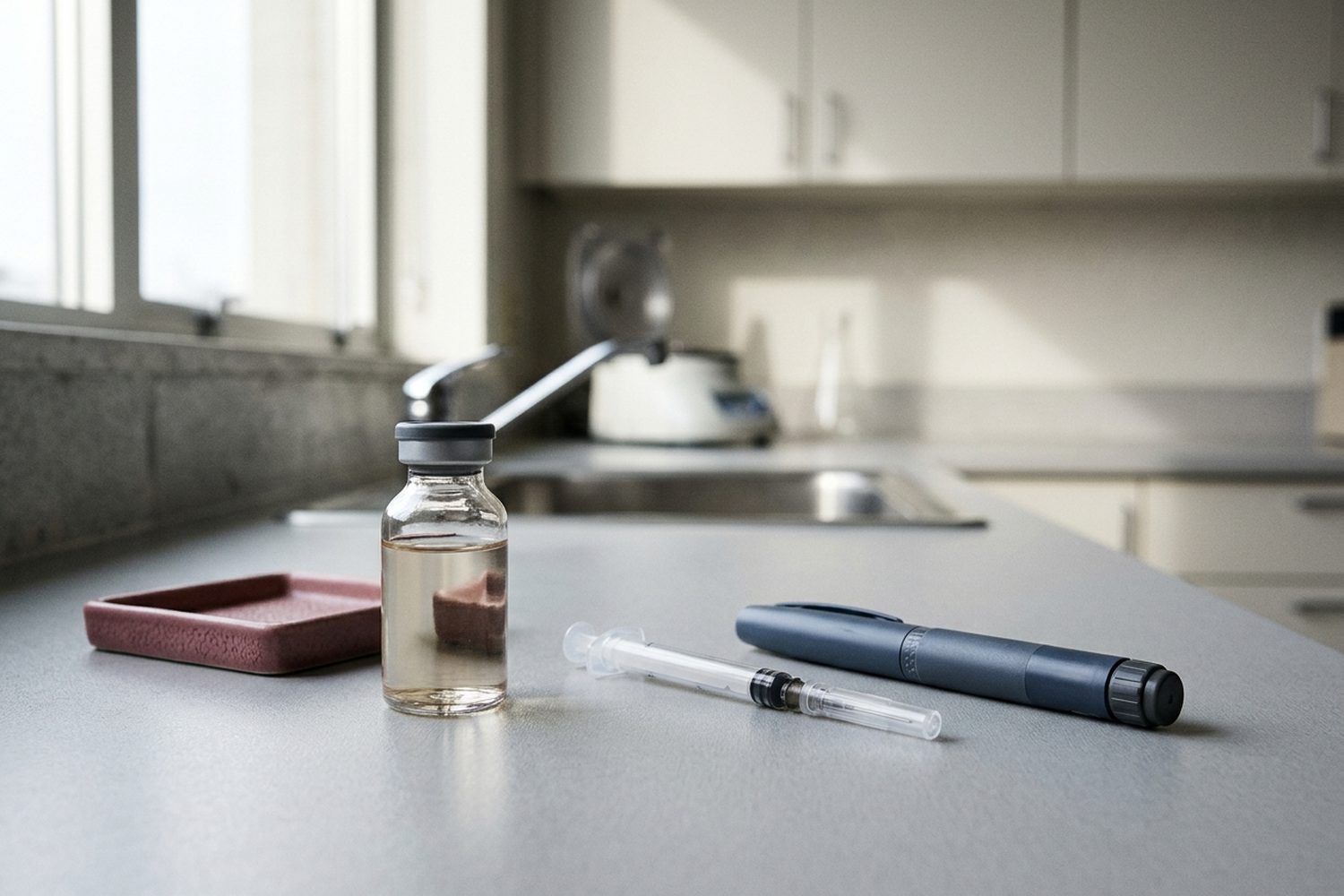
In 2023 a poison control center published a short case series about people who had injected the wrong amount of a weight-loss drug. One detail stands out. A patient got the drug from a compounding pharmacy as a vial and some syringes for self-administration, with no pharmacist counseling on how to actually administer it. That patient had compounded semaglutide: the active ingredient in Novo Nordisk’s Ozempic and Wegovy, made by someone other than Novo Nordisk, usually sold in a multiple-dose vial rather than a prefilled pen, and never approved by the FDA as a finished drug product.
So the plain answer to “what is it” is roughly this. It is the same molecule, more or less (the “more or less” is doing some work, and we will get to it), from a different source, with much less testing. It has never undergone FDA bioequivalence testing. It has no randomized trial data behind it. It typically cost patients between $150 and $400 a month. Its legal footing, as best you can read it off the calendar, was a drug shortage: the semaglutide shortage ended in February 2025, the deadline for 503B outsourcing facilities to stop making new batches was May 22, 2025, and the FDA prohibited distribution after that date. Some businesses kept selling anyway.
The dumb version of compounded semaglutide
Here is a deliberately dumb version, made up for illustration. A guy buys semaglutide powder from a factory overseas. He dissolves it in something sterile-ish, fills some vials, and ships them to strangers along with a bag of syringes. The strangers work out how much to inject by reading about the branded pen online and doing some arithmetic.
Obviously this is not allowed.
It is worth stating the dumb version anyway, because it isolates the three things that make the product what it is. The ingredient comes from somewhere other than the company that ran the trials. Nobody checks the finished vial the way a regulator checks an approved drug. And the dose is assembled at the end, by the patient, out of a vial, a syringe and some units.
The sophisticated version, with licenses and doctors
The real version is much more elaborate. There is a licensed compounding pharmacy (either a 503A pharmacy or a 503B outsourcing facility, a distinction with its own article on this site). There is a prescriber. There is, often, a telehealth brand with a nice website, a subscription and a monthly price well below the branded drug. The telehealth companies and the compounders hooked up in a big way, and for a while it was a very satisfying arrangement for everyone involved.
And there was a reason it was allowed: the branded drug was in shortage, and the timing of what happened when the shortage ended tells you the shortage was carrying the legal weight. (The exact mechanics of the shortage list are another article here; the dates above are the part that matters for this one.) I feel like everyone in the business understood this, which is why the end of the shortage produced so much creative thinking. “Hey, the shortage is over,” you can imagine a growth lead saying in a meeting, “but is it over over?”
Now walk the sophisticated version to its end. Where does the licensed pharmacy get the active ingredient? Who tests the finished vial before it ships? What does the patient hold at the end?
The same three answers.
Where the active ingredient comes from
Novo Nordisk does not sell its semaglutide to compounders, so compounders buy active pharmaceutical ingredient, or API, from other manufacturers. Novo, in a statement about its lawsuits, pointed to a Brookings Institution report that many compounded products rely on synthetic API imported from facilities in China that lack FDA oversight or quality controls. That’s Novo’s framing, and Novo presumably has its own interests here, but the underlying point about sourcing is not really in dispute.
There is also the “more or less” from earlier. Some compounded products used semaglutide salt rather than semaglutide base, and the salt version has a greater potential for drug instability and variability, which can raise the risk of side effects or of the drug just not working. (The salt forms get their own article; here it is enough to know that “semaglutide” on a label is a less specific word than it looks.)
The other odd thing about sourcing is that being a copy is sort of the point. When the FDA went after Empower Clinic Services, BioSpace reported, the agency found that Empower’s compounded tirzepatide and semaglutide products appeared to be copies of FDA-approved products. Patients wanted the approved drug, cheaper. A product that was not a copy would not have sold. A product that was a copy was, once the shortage ended, the problem.
What testing it gets before it reaches a patient
An approved drug goes through trials, review, manufacturing inspection, etc. A generic has to prove it is equivalent to the brand before approval. The compounded product does none of that. It is not tested for safety, potency or effectiveness before use, and it has not been through bioequivalence testing at all.
What testing exists happens at the pharmacy level, and the quality of it varies. One data point: FDA warning letters have cited subpotent semaglutide measured at 79.9% of its labeled potency. That’s a product that says one amount on the label and contains about four-fifths of it, which is the kind of stuff a finished-product review is designed to catch.
Whether any given compounder’s testing is good is not settled by any single number, and judging that is a whole separate article on this site.
Why the vial matters more than the molecule
On July 29, 2024, the FDA issued a MedWatch alert about dosing errors with compounded injectable semaglutide. Patients had given themselves five to 20 times the intended dose. By April 30, 2025, the FDA had received 520 adverse event reports tied to compounded semaglutide, and the reported effects included nausea, vomiting, abdominal pain, fainting, headache, migraine, dehydration, acute pancreatitis and gallstones, some requiring hospitalization.
The mechanism is not mysterious. The patient was supposed to pull the plunger back a little, and pulled it back a lot. The FDA’s MedWatch alert calls this “mistakenly drawing up more than the prescribed dose from a multiple-dose vial,” and it was the majority of the reports.
Let us set out the governing principle with the rigor it deserves. A multiple-dose vial is, by definition and by design, a container holding more than one dose. It follows, as a matter of plain construction, that a person drawing from it is physically able to draw more than one dose. The branded pen does not have this property. The poison control case series put it this way: vials “do not include the safety features provided by prefilled manufactured pens, making large overdoses (e.g., 10-fold dosing errors) possible.” Two of the three patients in that series had 10-fold errors.
Then add units. The FDA said confusion among milligrams, milliliters and syringe “units” contributed to the errors, and one patient in the case series dosed in milliliters and units instead of milligrams. It is also not just patients: some errors came from health care providers miscalculating doses, and the FDA warned that different compounders may sell different concentrations, so the same number of units out of two different vials can be two different doses.
Imagine (this is invented) a baking show where every contestant gets a recipe in cups, every pantry stocks flour in a different density, and the judges dock points for collapsed cakes. Somebody’s cake is going to collapse, and it won’t be because they can’t bake. A pharmacist writing at PrecisionOptimize made roughly this observation in clinical terms: most adverse events reported to MedWatch for compounded semaglutide appear to be dosing errors rather than formulation failures. The molecule was fine-ish. The packaging was the risk.
What happened after the shortage ended
Contrary Research summarized the aftermath flatly: after the shortage ended, some compounders and direct-to-consumer platforms kept producing, “resulting in regulatory scrutiny and legal action from the FDA and Novo Nordisk.” By August 5, 2025, Novo had filed 132 complaints in federal courts across 40 states, and courts had issued 44 permanent injunctions. The FDA sent warning letters to telehealth companies in three rounds, in September 2025, February 2026 and June 2026. A secret shopper study of 75 businesses found that 92% sold compounded semaglutide.
The most visible case: on February 5, 2026, Hims & Hers advertised the commercial launch of a compounded semaglutide tablet, and on February 9, 2026, Novo sued it for infringing US Patent No. 8,129,343, alleging it mass-compounded injectable versions of Wegovy made with inauthentic API. How that ends is not settled.
Now take the sophisticated version and keep making it more responsible, which is presumably what regulators would like. (Made-up scenario, to be clear.) A compounder verifies its API back to an FDA-inspected plant. Then it tests every batch for potency. Then, worried about vials, it ships in prefilled pens with a dial so nobody counts units. Then it runs a randomized trial, and a bioequivalence study, and submits it all to the FDA for review, and builds a factory big enough that there is never a shortage again. That’s fine. It is also a description of Novo Nordisk.
The most sophisticated compounded semaglutide possible is Wegovy at full price.
Sources
- How GLP-1s Broke Healthcare Distribution | Contrary Research
- Compounded Semaglutide vs. Ozempic: What's the Difference? | PrecisionOptimize
- FDA MedWatch - FDA Alerts Health Care Providers, Compounders and Patients of Dosing Errors Associated with Compounded Injectable Semaglutide Products
- Quality Control In Compounding Pharmacy: 2026 Checklist
- FDA and Novo Nordisk Warned of GLP-1 Telehealth Compounding Takedown. What’s Next? | Pharmacy Times
- FDA slams GLP-1 compounder over risk of contaminating drugs ‘with filth’ - BioSpace
- Administration errors of compounded semaglutide reported to a poison control center-Case series
- America's Poison Centers - GLP-1
- Compounded Semaglutide Dosage Chart: Titration Guide
- Businesses continue to sell compounded semaglutide, tirzepatide
- Compounded Semaglutide: Meaning and Why Regulators Warn
- Semaglutide Compounding Pharmacy: What's Legal In 2026
- FDA Warning Letters to Telehealth Companies Selling Compounded Drugs
- The Semaglutide Shortage Is Ending: What’s Next For Compounded Drugs?
- Compounded GLP-1 Marketing After the Shortage Ended
- Novo Nordisk expands legal action to protect US patients from unsafe, non-FDA-approved compounded "semaglutide"
- Is your compounded semaglutide and tirzepatide safe?
Compound GLP explains the law and published research. It is not medical or legal advice, and it never recommends a dose, a pharmacy or a product. Talk to a clinician before you start, stop or change any medicine.