What Independent Labs Found When They Tested Compounded Semaglutide
Nobody has to test the vial before it is injected, so the numbers we have come from regulators, independent labs, and poison control centers.
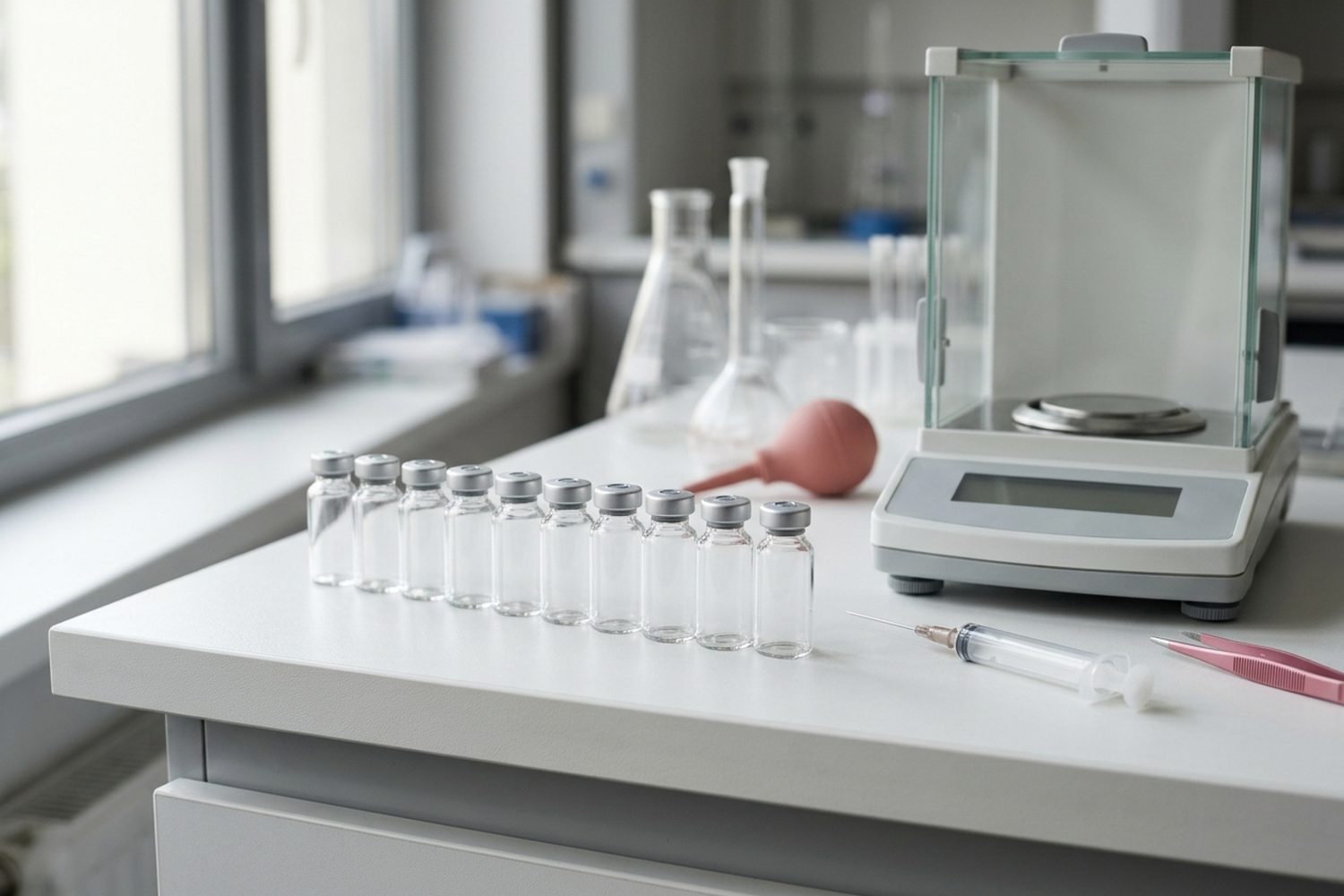
Here is the odd fact at the center of compounded semaglutide: nobody is required to check what is in the vial before a patient injects it. A compounded drug is not an FDA-approved finished product, and compounded semaglutide has never been tested for safety, potency or effectiveness before use. So the published record of compounded semaglutide testing is mostly what happens afterward, when regulators inspect a facility or an independent lab buys some vials and measures them.
The plain answer is that the numbers are scattered, and most of the systematic ones are for the sister drug, tirzepatide. FDA warning letters have cited compounded semaglutide measured at 79.9% of its labeled potency. For tirzepatide, independent labs report that roughly 17% of compounded vials fall below 90% potency. Another set of tirzepatide samples measured between 101% and 132% of the labeled amount, and an aggregated database of 1,062 third-party tirzepatide tests shows an average purity of 99.75%. On endotoxin (the bacterial residue that sterile injectables are supposed to keep out) the published results gathered here give no figures at all, so that question is not settled.
What a potency test actually measures
It is worth being very literal about this. A lab takes a vial, figures out how much drug is actually in it, divides that by how much the label says is in it, and writes down the ratio. If the label says 10 and the lab finds 8, the vial gets an 80. This is called a potency assay.
A purity test asks a different question. It is not “how much drug is in here” but “of the stuff in here that looks like drug, how much is the right drug, as opposed to fragments, byproducts, etc.” A vial can be perfectly pure and badly underfilled, the way a glass of water can be entirely water and also mostly empty.
Let the record therefore reflect the following finding, which I state with the full gravity of the profession: 132 is greater than 100, 79.9 is less than 100, and both numbers are on labels that said 100. Potency is the Price Is Right, except that going over also loses. (I write about vials for a website, so this is roughly the level of math I get to do in public.)
There are, roughly, three ways to read the spread between those numbers. They get less comfortable as they go.
The first reading: the spread is mostly noise
The friendliest reading starts with the purity figure. If 1,062 tests across labs including ILS Laboratories, Accumark Labs, Krause Analytical, Freedom Diagnostics, Janoshik Labs and Kovera Labs average 99.75% purity, then at least the molecule being made is, mostly, the molecule. That is not nothing.
On this reading, an 80 here and a 132 there are the tails of a distribution, and every manufacturing process has tails. A pharmacist writing at PrecisionOptimize argued that most adverse events reported to FDA MedWatch for compounded semaglutide “appear to be dosing errors rather than formulation failures.” If the vials were routinely poisoning people, presumably the adverse event reports would say so (adverse event reports being, in fairness, the place where people say so).
That’s fine as far as it goes. The problem is that it goes about as far as the data, which is not far. An average purity number tells you nothing about the vial with the lowest purity, and it is a tirzepatide number being asked to vouch for semaglutide.
The second reading: the spread is the product
The second reading is that variance is not a defect of this system but its natural output. An approved drug comes from a manufacturer that had to prove the thing works and keep proving it batch after batch. Compounded semaglutide never went through FDA bioequivalence testing, which even generics must pass before approval. Nothing upstream forces the numbers to cluster near 100.
Then there is the question of what goes into the vial. The FDA has reported that some compounders used different salt forms of semaglutide than the one in approved products, and using a salt instead of the base carries a greater potential for instability and variability. A Brookings Institution report noted that many compounded products rely on active ingredient imported from facilities in China that lack FDA oversight. When BioSpace covered the FDA’s findings about Empower Clinic Services, the agency’s finding was that Empower’s semaglutide and tirzepatide products were “essentially copies” of approved drugs, which is a separate legal problem but tells you how close to the original these things are trying to be.
Here is a scenario, entirely made up, to show where the incentives point. Suppose a telehealth brand learns that independent labs are publishing potency scores. It notices that nobody complains about a 112. So it overfills a little, and markets “verified 112% potency, more medicine per dollar.” A rival answers with 120. A third brand, charging somewhere in the $150 to $400 a month range that compounded semaglutide typically ran, launches a premium tier at 135. Eventually the label becomes a sort of floor, the tests become an advertising channel, and the one number nobody can find is the one printed on the vial.
That has not happened. I feel like it would not take much.
The third reading: the vial is not the main problem
The least comfortable reading is that the potency spread, which looks alarming, is the smaller of the two spreads. The bigger one happens after the vial leaves the pharmacy.
In a July 29, 2024 alert, the FDA said it had seen patients take five to 20 times the intended dose of compounded semaglutide. Most of those reports described people drawing up too much from a multiple-dose vial at home. The agency said confusion between milligrams, milliliters and syringe units may have contributed, and warned that compounded semaglutide comes in multiple concentrations. A 2023 case series from a poison control center found two of three patients had made tenfold errors, and pointed out that the vials “do not include the safety features provided by prefilled manufactured pens.” One patient got a vial and syringes with no pharmacist counseling; another measured in milliliters and units instead of milligrams.
Put the two spreads side by side. A vial at 132% potency is a third too strong. A dose drawn at ten times the intended volume is 900% too strong. If you multiply them, which is what actually happens inside a person, the lab’s finding is a rounding adjustment on the syringe’s finding. Reports of hospitalizations, acute pancreatitis and gallstones are what the FDA got back. By April 30, 2025, the agency had received 520 adverse event reports related to compounded semaglutide.
You can picture the conversation at the lab. “Hey, this batch came back at 132.” “Write it down.” “Should we flag it?” “Compared to what?” And that is the dumb part, structurally: the most careful measurement anyone takes of this product is precise to a decimal point, and it sits next to a patient measuring in syringe units that the label may not even use.
Why the semaglutide data is so thin
Part of the reason so many of these numbers are about tirzepatide is that semaglutide compounding was supposed to stop. The semaglutide shortage ended in February 2025, and the FDA set May 22, 2025 as the date after which distribution of compounded semaglutide and tirzepatide was prohibited. Some compounders and telehealth platforms kept going anyway. In a secret shopper study of 75 businesses, 92% were selling compounded semaglutide (the other 8% presumably had their reasons).
So the testing is, in a meaningful sense, testing of a product that is not supposed to exist in its current volume. The FDA has sent warning letters to telehealth sellers in rounds dated September 2025, February 2026 and June 2026. Novo Nordisk had filed 132 complaints in federal courts across 40 states by August 5, 2025, with 44 permanent injunctions issued, and in February 2026 it sued Hims & Hers, alleging its compounded semaglutide was made with inauthentic active ingredient. I would rather not think about what Novo’s lawyers have planned for complaint 133.
The result, I guess, is that the institutions with the most reason to measure compounded semaglutide are regulators building enforcement files and a drugmaker building lawsuits. The institution with the most direct, unplanned measurement of what a real dose of it does is the poison control center.
Sources
- Compounded Tirzepatide Potency Guide | Rx.com
- Compounded Semaglutide: Meaning and Why Regulators Warn
- FDA slams GLP-1 compounder over risk of contaminating drugs ‘with filth’ - BioSpace
- Tirzepatide Lab Tests & Shop Reviews: Dual GLP-1/GIP Agonist
- Compounded Semaglutide vs. Ozempic: What's the Difference? | PrecisionOptimize
- Quality Control In Compounding Pharmacy: 2026 Checklist
- FDA MedWatch - FDA Alerts Health Care Providers, Compounders and Patients of Dosing Errors Associated with Compounded Injectable Semaglutide Products
- America's Poison Centers - GLP-1
- Administration errors of compounded semaglutide reported to a poison control center-Case series
- Compounded Semaglutide Dosage Chart: Titration Guide
- Businesses continue to sell compounded semaglutide, tirzepatide
- How GLP-1s Broke Healthcare Distribution | Contrary Research
- FDA and Novo Nordisk Warned of GLP-1 Telehealth Compounding Takedown. What’s Next? | Pharmacy Times
- Semaglutide Compounding Pharmacy: What's Legal In 2026
- FDA Warning Letters to Telehealth Companies Selling Compounded Drugs
- Novo Nordisk expands legal action to protect US patients from unsafe, non-FDA-approved compounded "semaglutide"
- Is your compounded semaglutide and tirzepatide safe?
Compound GLP explains the law and published research. It is not medical or legal advice, and it never recommends a dose, a pharmacy or a product. Talk to a clinician before you start, stop or change any medicine.