Why Compounded Tirzepatide Costs What It Costs
Nobody publishes what compounded tirzepatide costs to make, but the brand price is walking down the street to meet it.
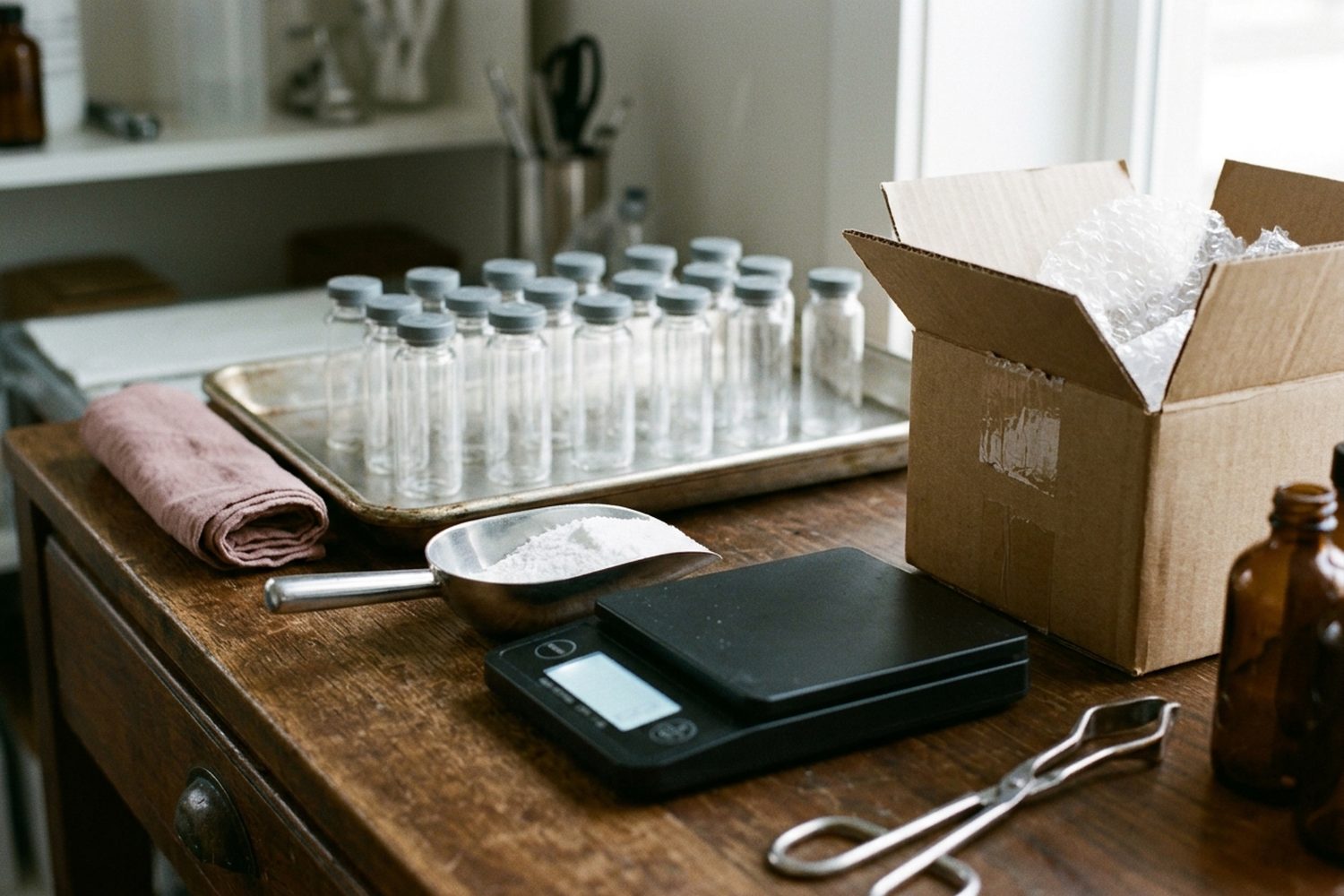
If you are a pharmacist, and a doctor calls about one patient who can’t use the commercial version of a drug, the job is fairly simple. You get the ingredient, mix it, put it in a vial and hand it over, and you charge for the powder, your time, the vial and a bit of profit. The price of that vial is basically the price of making one thing by hand for one person. It is a handmade price.
Compounded tirzepatide is that idea pushed a long way down the road, and the price is less tidy than you would hope. None of the sources I have puts a single number on compounded tirzepatide cost specifically. The closest figure is for its cousin: a 2026 legal explainer says compounded semaglutide “typically cost patients between $150 and $400 per month.” Brand-name versions of both drugs run $800 to $1,500 a month without insurance, and as of March 2026 Pharmacy Times reported that TrumpRx listed tirzepatide injections at $299 to $449 a month, against $1,087 for branded alternatives. So the compounded product lives somewhere in the low hundreds, and the brand has been walking down the street toward it.
Why the compounded tirzepatide price starts with a legal exception
The legal hook for compounding tirzepatide at all is narrow. Rx.com’s potency guide says it “can only be prepared when a prescriber attests that the commercial drug does not meet a patient’s medical need, often due to cost or supply issues.” Notice the word “cost” sitting in there. That’s fine, as far as it goes. A drug that costs $1,087 a month does fail to meet some people’s needs, in the sense that they cannot pay for it.
For the bigger outsourcing facilities, though, the FDA reads it differently. According to the law firm ArentFox Schiff, when the FDA assesses “clinical need” for its 503B bulks list, it does not consider “the cost of the compounded product compared with an FDA-approved drug.” Flatly: being cheaper than the real thing is not, to the FDA, a medical reason. So price is the entire reason the market exists, and price is the one thing the official test declines to look at. (The 503A versus 503B plumbing gets its own article on this site.)
Step two: buy the powder by the bag
Now escalate. Suppose (this is a hypothetical I am inventing) the pharmacist gets that call a hundred times a week. She stops ordering ingredient for one patient and starts buying bulk active pharmaceutical ingredient, the API, which is the actual drug as a powder. She stops mixing single doses and fills multi-dose vials, which for compounded tirzepatide range from 5 mg to 50 mg, diluted with bacteriostatic water. Each vial is weeks of product made in one go. The per-dose cost falls. That’s the trick.
What does the powder cost? I don’t know, and I mean that literally: none of my sources gives a per-gram price for tirzepatide API, and any number I offered would be invented. What they do describe is where powder like this comes from, which is presumably related to its price. A Brookings Institution report, cited by Novo Nordisk, said many compounded semaglutide products rely on API imported from facilities in China “that lack FDA oversight or quality controls.” Novo also alleged that Hims & Hers made injectable semaglutide with inauthentic API. And on February 6, 2026, the FDA announced steps to restrict GLP-1 APIs used in non-approved compounded products. Cheap inputs have reasons.
Bulk work has its own arithmetic. Rx.com notes that a 5 mg weighing error on a 50 mg batch produces a 10% potency swing, and that potency loss most often happens when pharmacies reconstitute bulk powder in unvalidated clean rooms. Independent labs report roughly 17% of compounded tirzepatide vials falling below 90% potency, and some lots contain as little as 72% of the stated dose. I feel like this is the line item nobody prints on the invoice. A vial that is 72% as strong is, in a dumb literal sense, a 28% discount that nobody asked for. (Accountants call this “shrink” when it happens to inventory; it is less charming when it happens inside a syringe.)
Step three: the telehealth markup, and why nobody can measure it
Escalate again. The pharmacist does not want to run ads, host video visits or answer customer email at 11 p.m. A telehealth startup does. It signs patients up, routes them to a prescriber, sends the prescription to a pharmacy, and ships a vial in a box with its own logo. ArentFox Schiff describes the compounded GLP-1 market as “fueled by telehealth startups and cash-pay obesity clinics.” It is a ghost kitchen: the restaurant on the delivery app has a name, a logo and nice photos, and the food comes out of a building you will never see.
The pharmacy, in this arrangement, is discreet. FDA warning letters repeatedly flagged telehealth companies branding products under their own names without disclosing which pharmacy compounded the drug. That is a fine arrangement for a brand and an awkward one for anyone trying to figure out who made the thing (or, more relevant here, who is keeping which slice of the monthly fee).
Because that is where the markup lives, and I can’t tell you how big it is. The sources do not split a monthly price into the pharmacy’s share and the platform’s share. Presumably the platform’s slice covers the prescriber, the advertising, the customer service, the shipping, the subscription software, profit, etc. Pharmacy margin is equally unpublished. (I write about compounding pharmacies for a living, and a surprising amount of the job is reporting which numbers do not exist.)
What does exist is a stack of letters. The FDA sent warning letters to telehealth sellers of compounded semaglutide and tirzepatide in rounds dated September 2025, February 2026 and June 2026, including 30 announced on March 3, 2026 and a third wave on June 8, 2026. FDA guidance says it is misbranding to describe a compounded product as a “generic version” of an approved drug or “the same as” one. The legal basis is Section 502(bb) of the Food, Drug, and Cosmetic Act, which, translated flatly, says you cannot lie in ads specifically about compounded drugs.
I am imagining the marketing meeting here, to be clear. “Hey team, can we call it the generic?” “No.” “Can we say it’s the same?” “Also no.” “Okay, what can we say about the ingredient?” Long pause.
The endpoint: the brand shows up at the compounder’s price
Push the hypothetical to its end. The platform grows until it is, functionally, the cheap generic of a drug that has no generic. It has a logo, a subscription, a price card and a celebrity ad, and somewhere behind it a pharmacy with a bag of imported powder. Then the manufacturer, rather than letting this continue, opens its own cash window and charges roughly the same price. Now the knockoff is competing on price with the original, at the original’s new price, while carrying all of the knockoff’s risks. Its one advantage was cost. That advantage is gone or whatever.
That sounds absurd, and the real world is most of the way there. TrumpRx’s tirzepatide range of $299 to $449 overlaps the $150 to $400 range reported for compounded semaglutide. Novo Nordisk announced on February 24, 2026 that it would cut the list price of Wegovy, Ozempic and Rybelsus to $675 a month across all doses, effective January 1, 2027. Meanwhile the shortage that made mass compounding possible is over (another article on this site covers how it ended), and the FDA, in deciding it had ended, reviewed Eli Lilly’s expanded manufacturing capacity.
The obvious reading, I guess, is that compounders discovered the price. They showed manufacturers that a huge number of people would pay a few hundred dollars a month, cash, for this drug, and the manufacturers then took the business back. Read the dates a second way, though, and the compounders discovered nothing: capacity expanded, the shortage ended, and the brand prices came down on their own schedule, with the compounders as a temporary bridge that happened to have good ads. The sources do not settle which story is the real one.
Back to the pharmacist with one vial
So return to the pharmacist and her one vial for one patient. It is still a vial. It now holds up to 50 mg, carries an app’s logo instead of her name, starts as powder from a facility nobody inspected, and gets priced against a government website listing the brand at $299. Somewhere in that chain, someone had to decide what to say about the ingredient.
Altru Telehealth’s website claimed its compounded semaglutide and tirzepatide contained an “FDA approved active ingredient.”
Sources
- Compounded Tirzepatide Potency Guide | Rx.com
- FDA and Novo Nordisk Warned of GLP-1 Telehealth Compounding Takedown. What’s Next? | Pharmacy Times
- The Shot Heard ‘Round the Pharmacy’: FDA Takes Aim at GLP-1 Compounders | ArentFox Schiff
- Semaglutide Compounding Pharmacy: What's Legal In 2026
- FDA Warning Letters to Telehealth Companies Selling Compounded Drugs
- Compounded GLP-1 Marketing After the Shortage Ended
- Is your compounded semaglutide and tirzepatide safe?
- Wegovy® & Ozempic® List Price Reduction | Novo Nordisk U.S.
- Fifth Circuit Upholds FDA on GLP-1 Shortage Decisions
- Novo Nordisk expands legal action to protect US patients from unsafe, non-FDA-approved compounded "semaglutide"
Compound GLP explains the law and published research. It is not medical or legal advice, and it never recommends a dose, a pharmacy or a product. Talk to a clinician before you start, stop or change any medicine.