Compounded vs Brand Semaglutide: The Differences That Matter
Compounded semaglutide is not Ozempic, and what remains of its legal footing rests on one sentence about who decides what is significant.
Here is a sentence from federal pharmacy law that has been asked to carry most of a weight-loss industry on its back. Under 21 U.S.C. § 353a, a compounded drug does not count as “essentially a copy of a commercially available drug product” if there is a change, made for an identified individual patient, that produces a significant difference between the compounded drug and the approved one, with that difference “as determined by the prescribing practitioner.” Most of what people mean by compounded ozempic lives inside that sentence, or is trying to.
So, plainly: compounded semaglutide is not Ozempic. Wegovy and Ozempic are the only FDA-approved semaglutide injection products. Compounded semaglutide is not FDA-approved as a finished drug product, and the FDA has not reviewed it for safety, effectiveness or quality. It is meant to be the same molecule, mixed by a pharmacy and usually sold in a multiple-dose vial rather than a prefilled pen, typically for $150 to $400 a month, against $935 to $1,349 for the brand without insurance. Its legal room shrank sharply after the FDA declared the semaglutide shortage over in February 2025. What remains is mostly that sentence.
What compounded ozempic is, compared item by item with the brand
Start with source. Novo Nordisk makes Ozempic and Wegovy, and it holds patents covering not just the semaglutide molecule but also the formulation, the delivery device and the manufacturing process. A compounder buys active ingredient from a supplier and makes its own preparation. Where that ingredient came from is a live question. Novo, for instance, has alleged that Hims & Hers mass-compounded injectable versions of Wegovy made with “inauthentic API” (a phrase that tells you what the API is not, without saying what it is).
Then formulation. The brand is one specific formulation. Compounded versions vary, and some have used salt forms of semaglutide. The FDA clarified that the listing of Wegovy and Ozempic on its shortage website never authorized compounding semaglutide sodium or any other salt form. Whether those salts behave like the brand is, as far as the sources here go, not settled (the site’s article on salt forms covers that ground).
Then device, testing and legal status, which get their own sections below, because each turns out to be weird in its own way.
Reading the copy rule one clause at a time
Take the sentence apart like a contract.
“Essentially a copy.” Not “a copy.” That qualifier means “a copy except in ways that do not matter,” so the whole legal fight is about which ways matter. A drug can differ from Ozempic in a dozen ways and still count, legally, as a copy of Ozempic. It can also differ in one way and not be.
“Commercially available.” During the shortage, the brand arguably was not, which is why compounders had room. Once the shortage ended, it was. Same drug, same pharmacy, different legal universe, decided by an entry on a government website (which is not how most universes get decided).
“A change made for an identified individual patient.” Every word here is singular. Identified. Individual. Patient. The statute pictures a pharmacist making something for a person with a name, maybe one who cannot tolerate an ingredient.
“Significant difference.” Significant to whom?
“As determined by the prescribing practitioner.” To the prescriber. That is the answer.
Who decides what counts as significant
Here is a second reading, and I do not think the text resolves it. One version: the prescriber’s judgment is the test, full stop, and if a licensed practitioner says the difference is significant for this patient, it is. The other version: significance is a real fact about the drug and the patient, and the prescriber is just the person whose job it is to notice it. The first reading is a bit like pickup basketball, where players call their own fouls. The second has a referee somewhere, though nobody has said where he stands.
Now a made-up scenario, clearly invented. A telehealth platform has 100,000 patients. Each gets a compounded semaglutide with the same tweak, and each prescription carries the same note saying the tweak is significant for this identified individual patient. A pharmacist calls the prescriber: “Hey, quick question, is Gary’s difference significant?” “Same as everyone’s.” “Great, and Linda?” “Also same as everyone’s.” Eventually the note is a checkbox, then the checkbox is pre-checked, then the form checks itself, and 100,000 individual determinations have been made by a dropdown menu. Each one, to be fair, is technically about an individual.
The FDA has offered its own reading, which is to count. In a warning letter reported by BioSpace, the agency found that Empower Clinic Services made tirzepatide and semaglutide products that looked like copies of approved drugs, and called the claimed differences “pretextual,” based on the company’s manufacturing volumes. So the FDA reads “individual” partly by looking at how many individuals there are (a method that is hard to argue with arithmetically). Does volume alone make a difference pretextual, or is volume just evidence that nobody was really individualizing? The letter, as reported, points at the volumes and stops.
Testing, and the number 79.9
The brand went through randomized trials and FDA approval. Compounded semaglutide has zero randomized trial data supporting its safety or efficacy, is not tested for safety, potency or effectiveness before use in the way approved drugs are, and has never undergone FDA bioequivalence testing, which generics must pass before approval. It is not a generic. It is a preparation.
Which brings us to a number. FDA warning letters have cited subpotent compounded semaglutide measured at 79.9% of labeled potency.
Not 80. Seventy-nine point nine.
Someone ran an assay precise enough to find the tenth of a percent, and the tenth of a percent says the vial was not quite four-fifths of what it said it was. I find this oddly moving. The measurement is excellent. It is the thing being measured that went soft. The label made a promise to one decimal place, and the lab kept it to one decimal place, and the two numbers are 20.1 points apart.
Anyway, by April 30, 2025, the FDA had received 520 adverse event reports related to compounded semaglutide. A pharmacist writing at PrecisionOptimize argues that most appear to be dosing errors rather than formulation failures. Which is the next section.
The pen, the vial, and the milliliter problem
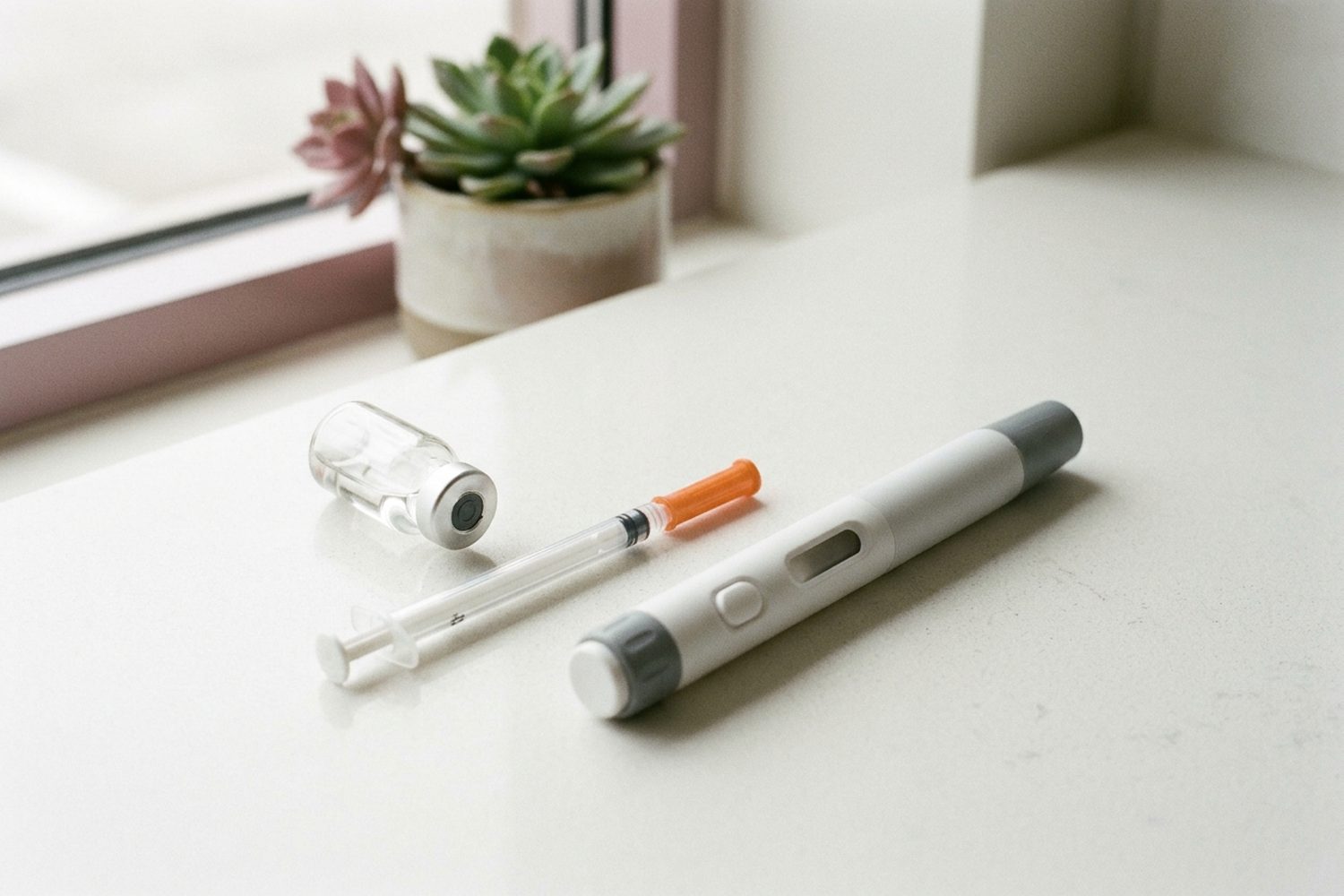
The device is where the side-by-side gets physical. Ozempic comes in a prefilled pen. Most compounded semaglutide comes in a vial with syringes. A 2023 case series of reports to a poison control center put it plainly: vials “do not include the safety features provided by prefilled manufactured pens, making large overdoses (e.g., 10-fold dosing errors) possible.” Two of its three patients self-administered 10-fold errors. One got a vial and syringes with no pharmacist counseling; one dosed in milliliters and units rather than milligrams.
On July 29, 2024, the FDA issued a MedWatch alert. The majority of its reports described patients drawing up more than the prescribed dose from a multiple-dose vial, sometimes five to 20 times more. Reported effects included nausea, vomiting, fainting, dehydration, acute pancreatitis and gallstones, some requiring hospitalization. The agency said confusion between milligrams, milliliters and syringe units may have contributed, and warned that multiple concentrations may be available. I mean, a pen is mostly a device for removing a unit conversion from someone’s kitchen. A vial hands the conversion back.
Where the legal status stands now
After the shortage ended, 503A pharmacies lost broad authorization to mass-produce near-identical copies, and the FDA prohibited distribution of compounded semaglutide and tirzepatide after May 22, 2025, the same deadline set for 503B outsourcing facilities. That leaves, look, the sentence we started with.
The market did not entirely notice. In one secret shopper study of 75 businesses, 92% sold compounded semaglutide. The FDA sent warning letters to telehealth sellers in rounds dated September 2025, February 2026 and June 2026. Hims & Hers advertised a compounded semaglutide tablet launch on February 5, 2026, and on February 9 Novo Nordisk sued it for infringing US Patent No. 8,129,343 (four days being, presumably, simply how long the mail takes). Novo was, in its understated way, unenthusiastic. How that case ends is not settled.
On the other hand, the price gap is the whole engine. Brand semaglutide can run upwards of $1,300 a month out of pocket; compounded versions in San Antonio ran $150 to $300 in 2026. It’s fine to notice that a gap that size makes people read statutes very carefully.
Read literally, the most legally durable compounded semaglutide business in America has exactly one customer, and his name is on the vial.
Sources
- Compounded Semaglutide Pricing Explained: Costs and Regulation
- How GLP-1s Broke Healthcare Distribution | Contrary Research
- Semaglutide Cost San Antonio: Compounded vs Brand – Dr. Rogers Centers
- Compounded Semaglutide vs. Ozempic: What's the Difference? | PrecisionOptimize
- FDA MedWatch - FDA Alerts Health Care Providers, Compounders and Patients of Dosing Errors Associated with Compounded Injectable Semaglutide Products
- Quality Control In Compounding Pharmacy: 2026 Checklist
- FDA and Novo Nordisk Warned of GLP-1 Telehealth Compounding Takedown. What’s Next? | Pharmacy Times
- 21 U.S. Code § 353a - Pharmacy compounding | U.S. Code | US Law | LII / Legal Information Institute
- FDA clarifies position on compounding semaglutide sodium
- FDA slams GLP-1 compounder over risk of contaminating drugs ‘with filth’ - BioSpace
- Administration errors of compounded semaglutide reported to a poison control center-Case series
- America's Poison Centers - GLP-1
- Compounded Semaglutide Dosage Chart: Titration Guide
- Businesses continue to sell compounded semaglutide, tirzepatide
- Compounded Semaglutide: Meaning and Why Regulators Warn
- Semaglutide Compounding Pharmacy: What's Legal In 2026
- FDA Warning Letters to Telehealth Companies Selling Compounded Drugs
- The Semaglutide Shortage Is Ending: What’s Next For Compounded Drugs?
- Compounded GLP-1 Marketing After the Shortage Ended
- FDA's Semaglutide Shortage Resolution: Legal Implications And Risks For Compounding Pharmacies | Legal 500
- The Semaglutide Shortage Is Ending: What’s Next For Compounded Drugs?
- Checking your browser - reCAPTCHA
- Checking your browser - reCAPTCHA
- Checking your browser - reCAPTCHA
Compound GLP explains the law and published research. It is not medical or legal advice, and it never recommends a dose, a pharmacy or a product. Talk to a clinician before you start, stop or change any medicine.