How Telehealth Weight-Loss Brands Built a Business on Compounders
Telehealth brands put their own names on shortage-era copies of weight-loss drugs, and the pharmacy that made the vial stayed out of view.
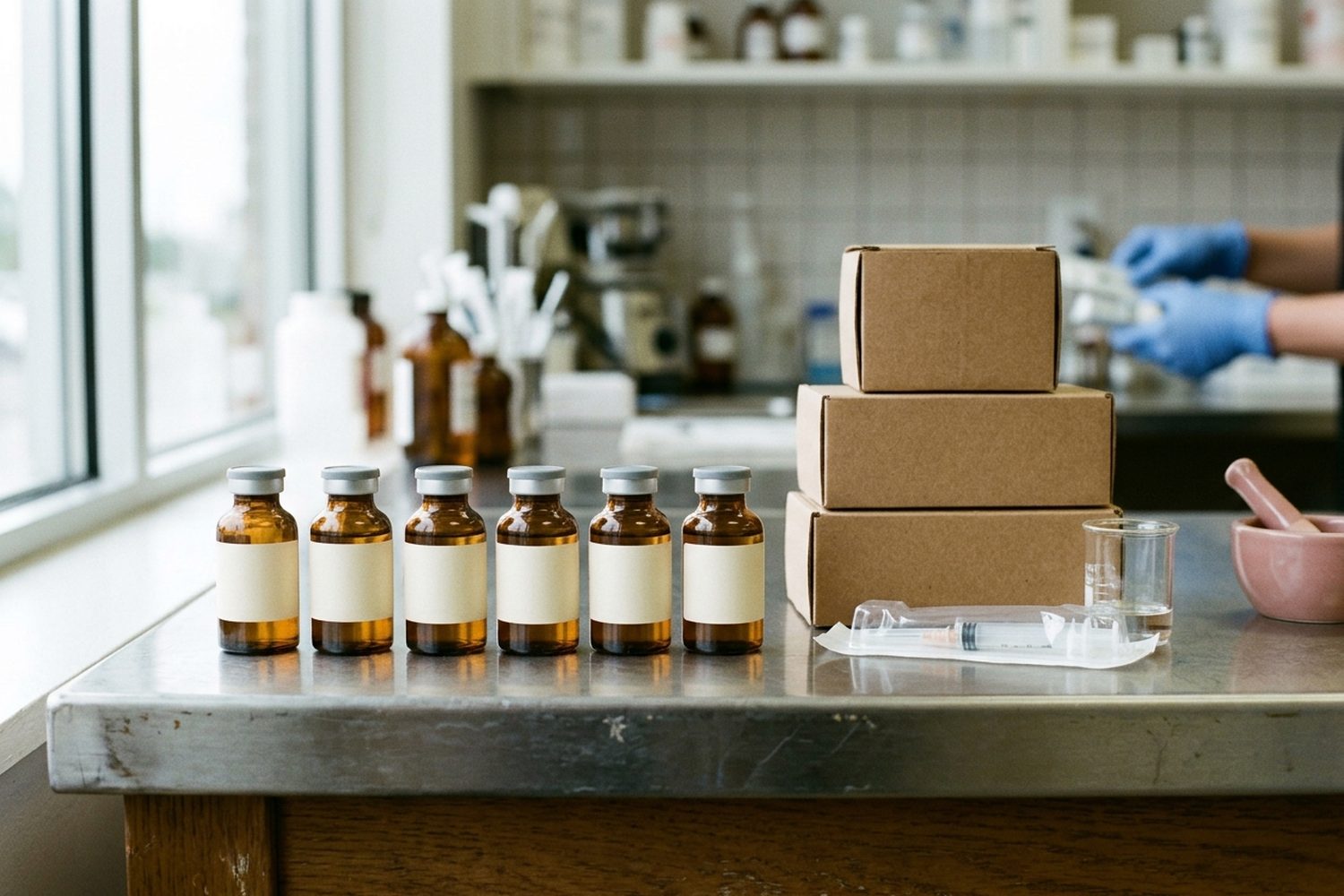
Here is a small fact about the weight-loss shots sold by telehealth websites: the name on the vial is often the website’s own, and the pharmacy that actually made the drug is often not named at all. The FDA lists that practice, branding a product under the telehealth company’s name without saying which pharmacy compounded it, among the recurring problems in its warning letters to these companies. A drug that one business makes and another business names is not unusual (most store-brand cereal works this way). It gets more interesting when the drug is a prescription injection and the copy was legal only because of a shortage.
A compounded GLP-1 is a version of a drug like semaglutide or tirzepatide made by a compounding pharmacy instead of by the company that owns the approval. Federal law ordinarily forbids compounding copies of approved drugs, but a shortage exception built into sections 503A and 503B lets compounders fill the gap while a drug sits on the FDA’s official shortage list. The pharmacies made the product. The telehealth companies found the customers, wrote the ads and put their name on the box. This article is about that second half: the supply arrangement, the advertising rules, and the attention it all drew from regulators.
Who gets paid when a compounded GLP-1 is sold online
Start with demand. The FDA approved Wegovy for weight loss in 2021, and Contrary Research calls that approval a key driver of the demand surge. Non-diabetic patients using GLP-1 drugs for weight loss went from 21,000 in 2019 to 174,000 in 2023. A survey in August 2025 found that nearly 12% of Americans had used a GLP-1 drug for weight loss at some point. That is a lot of people (it is also, to a marketing department, a very large audience). The manufacturers could not keep up, the drugs went on the shortage list, and the exception switched on.
Now the supply side. A compounding pharmacy is basically a business that is good at making sterile vials and, I assume, not especially good at search-engine advertising. A telehealth startup is the reverse: it has a checkout page, a marketing budget and a funnel full of people, and no drug. So the two hook up. It is a very discreet relationship, in the sense that only one of the partners is willing to be seen in public.
I imagine the founding conversation went something like this. “Hey, we have forty thousand people who clicked the ad and nothing to ship them,” says the growth lead. “We have a clean room and no website,” says the pharmacist. Everyone is doing their job well. The law firm ArentFox Schiff describes the result plainly: the compounded market “was fueled by telehealth startups and cash-pay obesity clinics.” At the 2024 peak, compounded versions reportedly accounted for up to 30% of total US GLP-1 supply.
Why the brand wanted its own name on the vial
If you run the website, the customer relationship is the only thing you own. The drug is the pharmacy’s. The prescribing is a doctor’s. The molecule is, in some sense, Novo Nordisk’s or Eli Lilly’s. What you have is a logo, an email list and a monthly charge. If the vial says the pharmacy’s name in large letters, the customer starts to wonder what exactly the monthly charge is for. So the logo goes on the vial and the pharmacy goes behind the curtain, which is the Wizard of Oz business model with a sterile-compounding license.
Here is a made-up example to show where this leads. Imagine ten telehealth brands, each with its own color scheme and its own influencer, all quietly buying from the same pharmacy. A customer cancels one brand for a cheaper one and receives the identical vial with a different sticker. She cancels again, for a third brand with a nicer font. Same vial. Eventually all ten brands raise prices, the customer starts her own brand to buy from the same pharmacy, and the pharmacy now has eleven customers and one actual patient. The FDA, meanwhile, would have to write ten letters about one product. (I made all of this up, though the sticker part is roughly what the warning letters describe.)
What the advertising rules actually say
The FDA’s warning letters rest on two provisions of the Federal Food, Drug, and Cosmetic Act. Section 502(a) prohibits false or misleading drug labeling. Section 502(bb) is specific to compounding and prohibits false or misleading advertising or promotion of a compounded drug. The second one is the interesting one, because it exists for exactly this situation.
The obvious thing an advertiser wants to say is that the product is the famous drug, just cheaper. Between us, if you had to write the ad copy, you would want to say that too, because “Wegovy” is what the customer typed into the search bar. The FDA’s guidance to telehealth companies treats this as misbranding: describing a compounded product as a “generic version” of an approved drug, or “the same as” one, or “clinically proven” to match its results. A compounded drug is not a generic. It is a copy that was permitted because of a shortage, which is a different thing with a different legal basis.
The letters show how close to the line the copy got. FWD Care’s website claimed its compounded product shared the same active ingredient as brand-name GLP-1 drugs. Altru Telehealth’s website said its compounded semaglutide and tirzepatide contained an “FDA approved active ingredient,” which is a sentence built so that the word “approved” lands near the product without quite attaching to it. As for the Federal Trade Commission, the usual referee for advertising claims: the sources behind this article describe FDA letters, not FTC actions, so what the FTC has done here is not settled by them.
What changed when the shortages ended
In February 2025 the FDA issued a Declaratory Order that the semaglutide shortage was resolved. Before doing so it gathered information from Novo Nordisk and also from patients, providers, compounders, outsourcing facilities and telehealth companies. It did something similar for tirzepatide, reviewing Lilly’s expanded capacity alongside submissions from, among others, telehealth companies. So the businesses whose legal basis depended on the shortage were asked whether the shortage was over (a question on which they had a fairly firm house view). I don’t know what they said. I can guess.
Alongside the order, the FDA posted an update titled “FDA Clarifies Policies for Compounders as National GLP-1 Supply Begins to Stabilize.” Translated into one flat sentence: the real drug is available again, so the reason you were allowed to make copies is going away. Contrary Research reports that some compounders and direct-to-consumer platforms kept producing anyway, which drew scrutiny from the FDA and legal action from Novo Nordisk.
Then came the letters. One source says that on September 9, 2025, the FDA sent more than 50 warning letters to GLP-1 compounders and online sellers, citing misbranding under 502(a) and 502(bb). Pharmacy Times says that on September 16, 2025, it sent more than 55 to online sellers. One account lists three rounds to telehealth companies, in September 2025, February 2026 and June 2026; another says the FDA announced 30 letters on March 3, 2026, and that a third wave went out on June 8, 2026. A February 2026 letter cited sameness and branding problems over compounded liraglutide. (My job, it turns out, is mostly reconciling warning-letter counts that do not agree.) The rough shape is settled. The exact tally, from these sources, is not.
The FDA also moved upstream. On February 6, 2026, it announced steps to restrict GLP-1 active ingredients used in non-FDA-approved compounded products. That is the regulatory equivalent of stopping the party by cutting off the ice delivery.
Where the chain ends up
Compounded semaglutide often comes in multi-dose vials, and the FDA has warned that different compounders may supply different concentrations. Its advice to health care providers who are unsure about a concentration is to contact the compounder. It also recommended giving patients the right syringe size for the intended dose. On July 29, 2025, the FDA warned of patients mistakenly giving themselves five to twenty times the intended dose and ending up in the hospital.
So follow the chain one more time. Demand created a shortage. The shortage created a legal opening for pharmacies. The pharmacies needed customers, the websites had customers, and the websites needed their own name on the vial so the customers would stay theirs. That meant the pharmacy’s name came off, or never went on. And the safety instruction for a confusing dose is: call the pharmacy.
The point is that the one fact the warning letters keep demanding, which pharmacy made this, is the fact the business was built to hide. After a boom in which compounded drugs reached as much as 30% of supply, the main lasting change to the vial may be that the supplier finally gets its name on it, in small print, under someone else’s logo.
Sources
- FDA Warning Letters to Telehealth Companies Selling Compounded Drugs
- How GLP-1s Broke Healthcare Distribution | Contrary Research
- Compounded GLP-1 Marketing After the Shortage Ended
- Fifth Circuit Upholds FDA on GLP-1 Shortage Decisions
- The Shot Heard ‘Round the Pharmacy’: FDA Takes Aim at GLP-1 Compounders | ArentFox Schiff
- GLP-1 Drugs: FDA Removes Semaglutide from the Drug Shortage List | Foley & Lardner
- FDA's Semaglutide Shortage Resolution: Legal Implications And Risks For Compounding Pharmacies | Legal 500
- Semaglutide Salt Forms: Why the Base Matters
- FDA MedWatch - FDA Alerts Health Care Providers, Compounders and Patients of Dosing Errors Associated with Compounded Injectable Semaglutide Products
- Compounded Semaglutide vs. Ozempic: What's the Difference? | PrecisionOptimize
- FDA and Novo Nordisk Warned of GLP-1 Telehealth Compounding Takedown. What’s Next? | Pharmacy Times
- Novo Nordisk expands legal action to protect US patients from unsafe, non-FDA-approved compounded "semaglutide"
Compound GLP explains the law and published research. It is not medical or legal advice, and it never recommends a dose, a pharmacy or a product. Talk to a clinician before you start, stop or change any medicine.